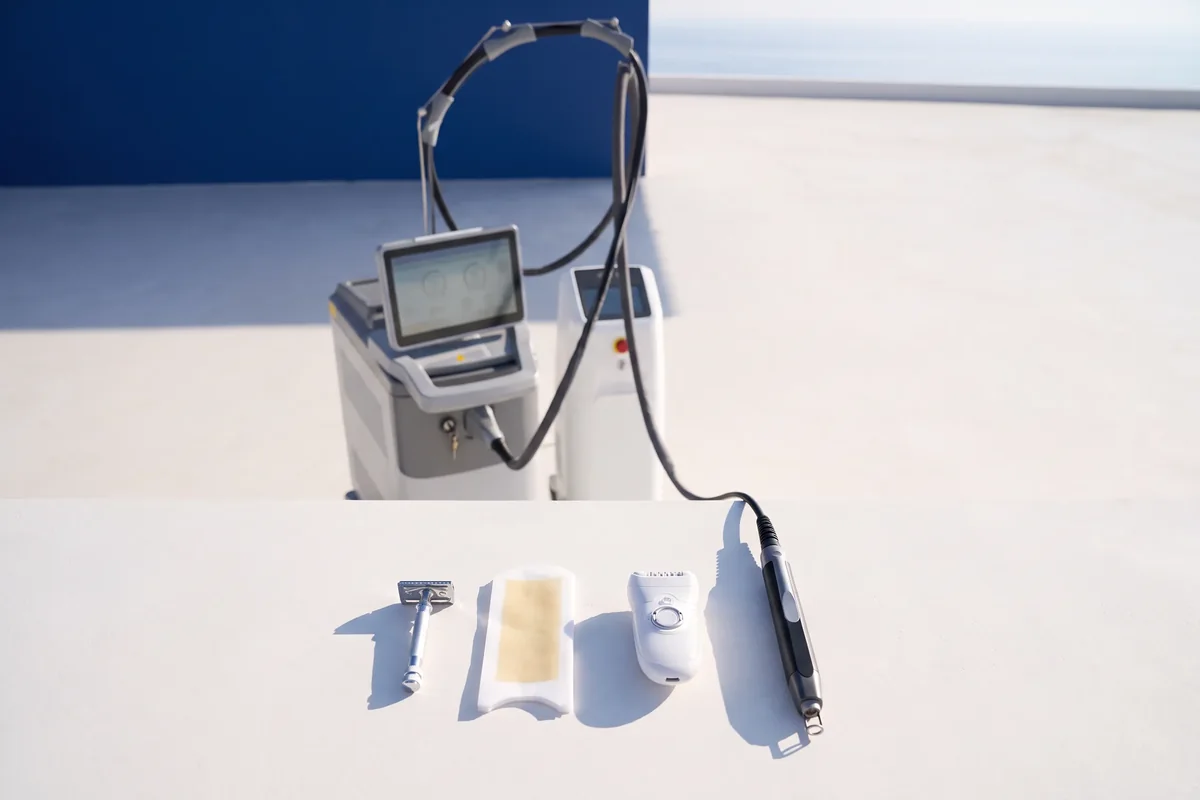
The essentials at a glance
- Only Laser, IPL and electrolysis damage the root and permanently reduce hair¹; shaving, waxing, sugaring, epilators and creams only have a temporary effect.
- Laser (Alexandrit 755 nm, Nd:YAG 1064 nm): eight to twelve sessions, all skin types with two wavelengths, permanently¹ hair-free after the series.
- IPL: flashlamp without a fixed wavelength, cheaper per session, ten to fifteen sessions, not suitable for dark skin.
- Electrolysis: hair by hair with a probe, the only method for grey, white and light blonde hair, only for small areas.
- Over ten years, a course of laser treatments for the legs costs 1.800 €, waxing around 6.000 €, and shaving around 1.200 € plus 300 hours of your time.
What "permanent" means in hair removal
Permanent hair removal refers to methods that damage the hair root so much that significantly less hair grows back in the treated area long-term, unlike shaving, waxing or epilation, which only remove the visible hair.
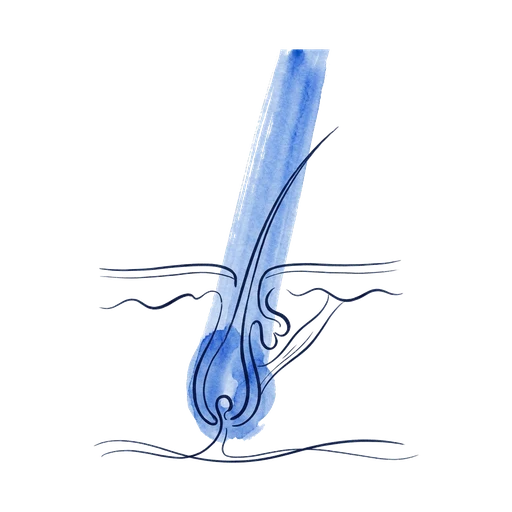
Three methods meet this definition: Laser, IPL and electrolysis. All three target the root, but in different ways: Laser and IPL use light that is converted into heat by the hair pigment, while electrolysis uses an electrical current via a fine probe in the hair follicle. All other methods, from shaving and sugaring to hair removal creams, leave the root intact. The hair grows back as soon as the next cycle begins.
"Permanent" doesn't mean "every single hair forever" with any method. The US FDA allows laser to be described as "permanent hair reduction", meaning permanent¹ reduction: a stable decrease in the number of hairs over a period longer than a complete hair cycle. This is exactly how we use the word in this comparison.
Why every permanent method needs multiple sessions
Hair grows in cycles consisting of a growth phase, a transition phase and a resting phase. The root is only active and supplied with pigment and blood vessels during the growth phase, which is the only time it can be reached with light or current. Because only 20 to 30 percent of the hair in each zone is growing at the same time, each session only catches this portion. That's why laser requires eight to twelve sessions, IPL usually ten to fifteen, and electrolysis 15 to 30 appointments depending on the area. This biology applies to every provider, no matter what the advertising promises. The review by Gan and Graber 2013 summarises the connections between hair cycle, zone and number of sessions.
Laser: Alexandrit, diode, Nd:YAG
Laser hair removal uses light of a single wavelength that hits the skin in a concentrated beam, is absorbed by the hair pigment, and heats the root – the principle of selective photothermolysis according to Anderson and Parrish.
Three types of lasers are common for hair removal. The Alexandrit laser at 755 nm has the highest pigment absorption and is the most efficient for light to medium skin, even for finer hair. The diode laser at 808 to 810 nm sits in the middle and is widely used in beauty studios because the devices are cheaper. The Nd:YAG laser at 1064 nm penetrates the deepest, protects the pigmented epidermis, and is the safe choice for dark and tanned skin. The Cochrane review by Haedersdal and Gøtzsche 2006 confirms that Alexandrit and diode have the best clinical evidence, showing around 50 percent hair reduction six months after treatment, usually after just a few sessions.
Strengths: precisely adjustable to skin type and hair, covers large areas quickly (underarms ten minutes, legs 45 minutes), well-proven, with two wavelengths for all skin types. Limits: needs pigment in the hair, so no effect on grey and very light hair; break from the sun around each session; eight to twelve appointments. Find out more in our guides Alexandrit laser and Alexandrit or Nd:YAG.
IPL: the flashlamp
IPL (Intense Pulsed Light) isn't a laser, but a xenon flashlamp. Its broad light spectrum of around 500 to 1200 nanometres is narrowed down by filters and applied over a wide area of the skin.
Because the light isn't concentrated and contains many wavelengths, the energy scatters more in the skin. A portion reaches the root, while another portion is absorbed by the epidermis and surrounding tissue. This makes IPL quite effective for light skin and dark hair, but less efficient than a laser: more sessions, less reduction per session, and a higher risk of burns and pigmentation spots on darker skin because the short wavelengths in the spectrum are heavily absorbed by the skin pigment. IPL is not suitable for skin types V and VI.
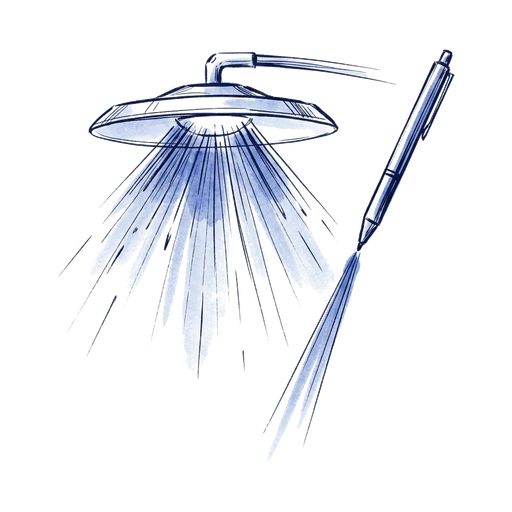
The big difference is between studio IPL and at-home devices. Professional IPL machines work with energy densities that can achieve a reduction. For safety reasons, at-home devices are limited to a fraction of this power and tend to slow down growth rather than stop it. The Federal Office for Radiation Protection (BfS) points out that IPL also falls under the NiSV and may only be used in studios by trained professionals.
Strengths: cheaper devices, meaning lower session prices; large treatment windows; well-tolerated on light skin. Limits: no fixed wavelength, less targeted, not for dark skin, ten to fifteen sessions, at-home devices have very limited effects.
Electrolysis: hair by hair
Electrolysis (needle epilation) is a procedure where a very fine probe is inserted into the individual hair follicle and a short electrical pulse destroys the root, regardless of hair and skin colour.
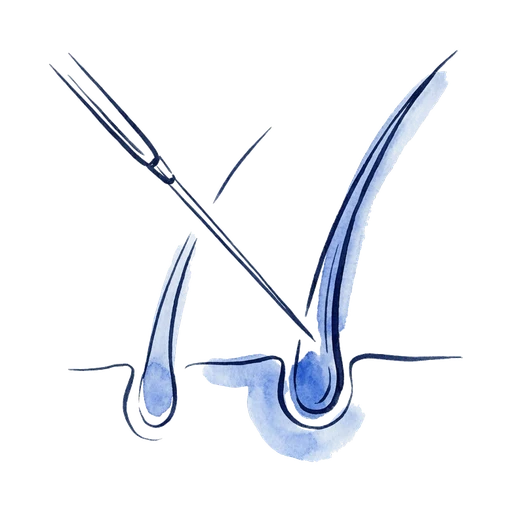
Electroepilation is the oldest method of permanent hair removal and the only one that also targets grey, white, light blonde and red hair, because it doesn't need pigment. There are three variations: electrolysis with direct current, thermolysis with high frequency, and the blend method as a combination. All three treat one hair at a time.
That's exactly where its limits lie. A 30-minute session clears about 100 to 300 hairs, depending on the practitioner's skill. This is ideal for the upper lip, chin or stray hairs left after a course of laser treatments, but impractical for legs or backs with tens of thousands of hairs. You can feel the treatment – a quick prick for each hair – and poor technique can lead to small scars or pigmentation spots. You're charged by time, usually 60 to 120 € an hour.
Strengths: works on every hair and skin colour, the only option for grey and white hair, highly precise. Limitations: extremely time-consuming, only for small areas, more painful than laser, depends on the practitioner's skill.
Shaving, waxing, sugaring, epilators, cream
Temporary hair removal includes all methods that remove the hair above or at the root, but leave the root itself intact, so the hair grows back completely in the next cycle.
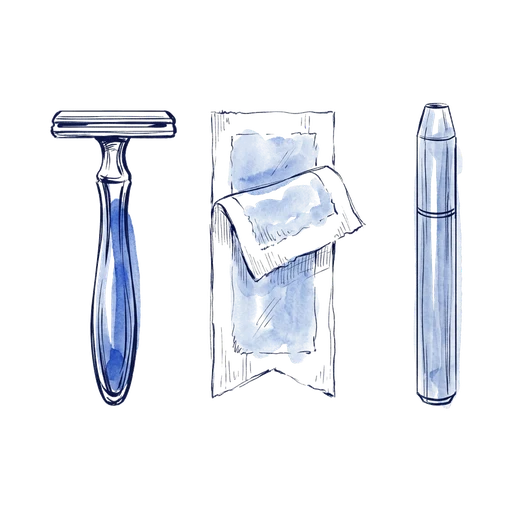
Shaving cuts the hair at the surface. It grows back after one to three days with a blunt edge, which feels stubbly but doesn't make the hair thicker. Risks include cuts, razor burn and ingrown hairs. Cost: around 10 € a month. Waxing and sugaring pull the hair out by the root. This lasts three to six weeks, the hair needs to be four to five millimetres long beforehand, and the procedure is painful. Risks include ingrown hairs, inflamed follicles and, with waxing, skin irritation from the heat. Cost: 30 to 60 € per zone and appointment.
Epilators mechanically pull the hairs out using rotating tweezers, with similar results and risks to waxing, but done at home. Hair removal creams chemically dissolve the hair at the surface, last a few days like shaving, and can irritate sensitive skin. None of these methods reduce the amount of hair. If you're planning a course of laser treatments, you also have to stop using them four weeks before each session, because the laser needs the root. Only shaving is allowed between sessions.
All methods in one table
| Criterion | Laser (Alexandrit, Nd:YAG) | IPL | Electroepilation | Waxing, sugaring | Shaving |
|---|---|---|---|---|---|
| Effect on the root | permanently¹ hair-free after the course | permanent¹, less per session | permanent¹, hair by hair | none | none |
| Skin types | all six with two wavelengths | I to IV, dark skin unsuitable | all | all | all |
| Hair colours | dark to medium brown, partly red | dark to medium brown | all, including grey and white | all | all |
| Sessions | six to ten | ten to fifteen | 15 to 30 and more | every three to six weeks, permanent | every one to three days |
| Duration per session | 10 to 45 minutes per zone | 15 to 60 minutes | 30 to 60 minutes for a few hairs | 15 to 45 minutes | 5 minutes |
| Sensation | quick pinch, cooling | warmth, tingling | prick per hair | pulling pain | none |
| Typical costs | Underarms 48 €, legs 180 € per session in a package of 10 | 20 to 80 € per session | 60 to 120 € per hour | 30 to 60 € per appointment | 10 € per month |
| Sun avoidance | two weeks before and after | two weeks before and after | none | 24 hours after | none |
| Regulation | NiSV, certification required | NiSV, certification required | none specific | none | none |
Costs over ten years
Over ten years, a one-off course of laser sessions is cheaper than waxing and costs about the same as a course of IPL, which requires more sessions and isn't an option for dark skin. Shaving is the cheapest but costs time: five minutes a day adds up to 30 hours a year. You can find the exact prices per zone at Laserazor under Prices, for example, underarms 48 €, upper lip 37 €, full intimate 86 € and full legs 180 € per session in a package of 10. Packages are valid for 24 months, or you can choose the VIP flat rate from 109 € a month.
Which method for who
| Situation | Recommendation | Why |
|---|---|---|
| dark hair, light skin, large area | Laser, Alexandrit 755 nm | highest efficiency, eight to twelve sessions |
| dark hair, dark or tanned skin | Laser, Nd:YAG 1064 nm | gentle on the pigmented epidermis, IPL unsuitable |
| grey, white, light blonde hair | Electroepilation | only method that doesn't require pigment |
| red hair | test laser, otherwise electrolysis | pheomelanin absorbs light poorly |
| few remaining hairs after laser sessions | Electroepilation | precise, small number |
| smooth once for your holiday | waxing or sugaring | lasts three to six weeks, no course needed |
| Pregnancy | shaving, waxing | pause laser and electrolysis during pregnancy |
| small budget, fair skin, patience | IPL in the studio | cheaper per session, more appointments |

If you're unsure, a ten-minute skin type check will sort it out. At Laserazor, this check is part of your 0 € trial session, and our specialists will be honest with you if laser isn't the right method for your hair. Read more about weighing up your options in our guide Pros and cons.
The best method per area
| Zone | First choice | Alternative | Note |
|---|---|---|---|
| Upper lip, chin | Laser | Electrolysis for fair hair | small area, often hormonally influenced, face tends to need ten sessions |
| Underarms | Laser | IPL for fair skin | reacts quickly, ten minutes per session, less sweat odour as a side effect |
| Bikini line, full intimate area | Laser | Sugaring, if a series of sessions isn't wanted | ingrown hairs disappear, more sensitive than legs |
| Legs | Laser | IPL, waxing | large area, 45 minutes per session, biggest time saver over the years |
| Back, shoulders | Laser, often Nd:YAG | Waxing | thick male hair, can't reach it yourself, 40 minutes per session |
| Chest, stomach | Laser | Shaving to thin out | thinning out is also possible, with longer intervals |
| Beard line, back of the neck | Laser | Electrolysis for contours | the beard stays, only the neck and cheeks are lasered |
| Eyebrows, ears | Electrolysis, tweezers | none | Laser near the eyes is not permitted |
The table shows why most people with dark hair end up choosing laser: it's the top choice for almost every area. Electrolysis remains the add-on for light hair, contours and leftover hair, while waxing and sugaring are the solution for anyone who doesn't want a course of treatments.
Five mistakes when comparing methods
1. Comparing prices per session instead of per course
An IPL session for 25 € sounds cheaper than a laser session for 48 €. But what really matters is the total cost of the course: twelve to fifteen IPL sessions compared to six to ten laser sessions. Always calculate the cost of the entire course and ask if a price covers the full zone.
2. Confusing 'laser' with 'light'
Many studios call IPL 'laser' or 'diode light'. A laser has a wavelength in nanometres that the studio can tell you. Anyone who just says 'light technology' is working with a flashlamp.
3. Ignoring your skin type
What worked for your fair-skinned friend can leave marks on dark skin. Every light-based method has to suit your skin type. For skin types V and VI, only Nd:YAG or electrolysis is safe.
4. Waxing or epilating between sessions
If you wax during a laser or IPL course, you remove the root that the light needs. The next session will then hardly work. Only shaving is allowed between sessions.
5. Expecting to be 'done after one session'
No method can do this in one session. After a complete laser series of eight to twelve sessions, the zone is permanently¹ hair-free. Electrolysis also achieves this on small areas, but takes many hours.
Combinations that work in practice
| Combination | How it works | Who it's for |
|---|---|---|
| Laser, then electrolysis | Laser reduces the area, the probe takes care of the few remaining light or grey hairs | Face, chin, bikini line with mixed hair colours |
| Nd:YAG, then Alexandrit | Nd:YAG thins out thick dark hair, Alexandrit catches the finer ones at the end | Skin type III and IV, back and legs |
| Laser plus shaving | Shaving between sessions, never waxing | every laser series |
| Waxing until you start laser | last waxing at least four weeks before the first session | anyone switching from waxing to laser |
What doesn't work: laser and IPL at the same time on the same area, because the energy and reactions overlap, and electrolysis on large areas as a substitute for laser, because the hours are unaffordable. If you're unsure, start with a skin type check and a trial session. You can find more on weighing your options in our guide Pros and cons.
Safety and legal
In Germany, laser and IPL fall under the NiSV (NiSV 2018). Since late 2020, both hair removal methods can only be performed by certified professionals, whether in studios or clinics. Electrolysis, waxing and shaving aren't regulated separately. For all light-based treatments, the rule is: your skin type according to Fitzpatrick 1988 determines the wavelength and energy, cooling protects the outer layer of your skin, and test pulses before your first session show how your skin reacts. A studio that just dives straight in is saving time at your expense.
How Laserazor works
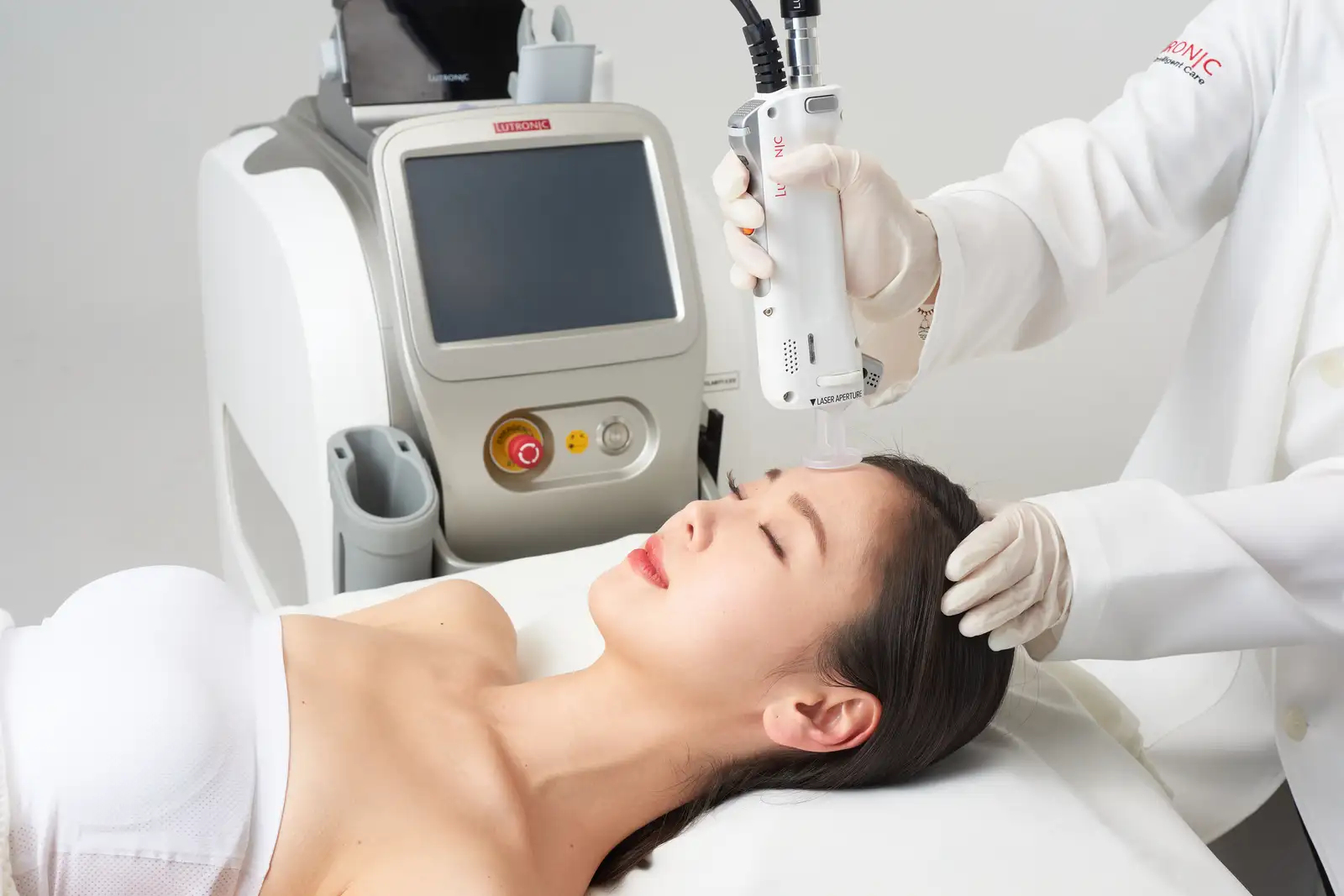
Laserazor treats you in six studios: Berlin Pestalozzistraße 13 and Danckelmannstraße 24 (both Charlottenburg), München Steinstraße 57 (Haidhausen) and Westendstraße 142, Augsburg Unter dem Bogen 2 and from 26 October 2026 Hamburg Poststraße 36. In Berlin, München and Augsburg we work with the Lutronic Clarity II (Alexandrit 755 nm and Nd:YAG 1064 nm) and in Berlin and München additionally with the DEKA Again Pro, in Hamburg with the Candela GentleMax Pro Plus. All devices are class IIb medical products with cooling right before every pulse. This means we cover all six skin types. Every specialist has NiSV certification, every first treatment starts with a skin type check and test pulses, and the skin is cooled before every pulse. Over 2.600 Google reviews with 5,0 stars show how much our clients love it.
Try the laser: 0 € trial session for a complete zone
Skin type check, test pulses and a complete zone, like your underarms or bikini line, for 0 €. No purchase, no subscription, no strings attached. After two to three weeks, you'll see the hairs shedding.
Frequently Asked Questions
Which hair removal method is truly permanent?
Laser, IPL and electrolysis damage the hair root and reduce hair growth long-term. Laser is the fastest and most effective method for dark hair, while electrolysis is the only option for grey and very light hair. Shaving, waxing, sugaring, epilators and hair removal creams only work temporarily.
What is the difference between laser and IPL?
A laser emits focused light of a single wavelength and can be precisely adjusted to your hair and skin type. IPL is a broad-spectrum flashlamp, and its energy scatters more widely in the skin. IPL is cheaper, takes more sessions and isn't suitable for dark skin.
Which method works for grey or blonde hair?
Only electrolysis, because it doesn't rely on pigment. Laser and IPL work through the hair's pigment and can't treat grey, white or light blonde hair.
How many sessions does each method need?
Laser eight to twelve, IPL ten to fifteen, electrolysis 15 to 30 and more appointments depending on the area. The reason is the hair cycle: only hair in the growth phase can be reached, and that's only 20 to 30 percent at a time per zone.
Is at-home IPL worth it?
For safety reasons, at-home devices are limited to a fraction of the energy. They can slow down hair growth on light skin with dark hair, but they rarely achieve a permanent reduction and aren't approved for dark skin.
Which method is the most affordable?
In the short term, shaving at around 10 € a month. Over ten years, a course of laser sessions is cheaper than waxing: full legs at Laserazor cost 1.800 € for ten sessions in a package, while ten years of waxing is around 6.000 €.
Which method is the least painful?
Shaving and hair removal cream are painless. Laser with cooling is described as a quick pinch per pulse, IPL as warmth and tingling, waxing as a pulling pain, and electrolysis as a prick per hair.
Can I combine methods?
Yes, and it often makes sense: laser for larger areas, followed by electrolysis for the few remaining light or grey hairs. Between laser sessions, only shaving is allowed, because waxing and epilating remove the root that the laser needs.
Which methods are regulated in Germany?
Laser and IPL fall under the NiSV and since late 2020 can only be performed with certified expertise. Electrolysis, waxing and shaving are not separately regulated.
Sources
The expert statements in this guide are based on the following sources. For each source, you'll find who wrote it, when it was published and its status.
- Haedersdal M, Gøtzsche PC (2006). Laser and photoepilation for unwanted hair growth. Cochrane Database of Systematic Reviews, Issue 4, CD004684. systematic review (Cochrane). View source. Evaluates randomised trials: Alexandrit and diode lasers show a hair reduction of around 50 percent up to six months after treatment; data for IPL and Nd:YAG was thinner at the time. Long-term data over years was missing in the evaluated studies.
- Gan SD, Graber EM (2013). Laser hair removal: a review. Dermatologic Surgery, Volume 39, pages 823 to 838. peer-reviewed review article. View source. Summarises research, side effects and treatment parameters; confirms the role of the hair cycle for the number of sessions.
- Anderson RR, Parrish JA (1983). Selective photothermolysis: precise microsurgery by selective absorption of pulsed radiation. Science, Volume 220, pages 524 to 527. peer-reviewed article. View source. Describes the principle behind all laser hair removal: light of a suitable wavelength and pulse duration specifically heats pigmented structures, while the surrounding tissue remains unharmed.
- Fitzpatrick TB (1988). The validity and practicality of sun-reactive skin types I through VI. Archives of Dermatology, Volume 124, pages 869 to 871. peer-reviewed article. View source. Defines the six skin types based on their reaction to the sun, which remain the basis for choosing wavelength and energy today.
- Federal Government (Regulation) (2018, in effect since 31.12.2020). Ordinance on Protection against the Harmful Effects of Non-Ionising Radiation in Human Applications (NiSV). Federal Law Gazette 2018 Part I, page 2034. statutory order. View source. Regulates who is allowed to use lasers and IPL on humans. For hair removal, proven expertise is mandatory; treatments that intentionally damage tissue are reserved for doctors.
- Federal Office for Radiation Protection (BfS) (continuously updated). Laser and IPL hair removal: Information from the Federal Office for Radiation Protection. bfs.de, optical radiation topic area. official information. View source. Explains the operating principle and risks (redness, pigment changes, burns from incorrect energy) and recommends application by qualified professionals.
- Laserazor (as of 9. September 2026). Laser hair removal price list, all 31 zones. laserazor.de/preise. own price list. View source. Single sessions and packages of 3, 5 and 10 sessions, valid in all studios, 24-month duration.
¹ 'Permanent' means: after a complete series, no hair that the laser has reached will grow back in the treated zone. No laser can reach grey, white and very light hairs. Hormonal changes can trigger new growth, in which case a top-up session is usually enough.

NiSV-certified specialists from the Laserazor studios in Berlin, München, Augsburg and Hamburg. They treat clients every day using Alexandrit and Nd:YAG lasers and write down exactly what they explain in the studio: no marketing fluff, just facts with sources.
This guide provides general information and doesn't replace medical advice, diagnosis or treatment. Laser hair removal is a cosmetic procedure; if you have skin conditions, take medications that increase light sensitivity, are pregnant or have unexplained hair growth, it makes sense to get medical advice first.

 Technology