
- Physical basis: selective photothermolysis
- Alexandrit laser — 755 nm in detail
- Diode laser — 800–810 nm in detail
- The role of Nd:YAG (1064 nm) in the combined system
- Chromophores: how melanin reacts to wavelengths
- Fluence, pulse duration, spot size — the crucial parameters
- Direct technology comparison
- How we combine both wavelengths
- Frequently asked questions

Alexandrit + Nd:YAG safely covers all skin types
Alexandrit (755 nm) is highly absorbed by hair melanin and works highly efficiently on light skin with dark hair. Nd:YAG (1064 nm) penetrates deeper and is objectively the right choice for dark skin. Only the combination of both wavelengths in a dual device covers the complete Fitzpatrick spectrum I–VI — anything else is a compromise.
The physical basis: selective photothermolysis
All professional laser hair removal is based on an active principle first described by Rox Anderson and John Parrish in 1983 in the journal Science: selective photothermolysis. The principle states that a light pulse with a suitable wavelength and short duration delivers energy precisely into a specific tissue structure without significantly heating the surrounding tissue.
For hair removal, the target structure is the melanin in the hair shaft and hair root. The pigment absorbs the laser light, converts it into heat and damages the hair matrix as well as the bulge region (English: bulge), where the stem cells of the hair follicle are located. If these structures are permanently¹ inactivated, the hair usually stops growing back in this area.
For this to work, three variables need to align:
- Wavelength: needs to be sufficiently absorbed by the melanin without significantly heating other structures (haemoglobin, water).
- Pulse duration: needs to be short enough so the heat stays in the target structure and doesn't escape into the surrounding tissue.
- Energy density (fluence): needs to be high enough to thermally damage the hair matrix, but not so high that it damages the epidermis.
Alexandrit and diode lasers approach these conditions with different wavelengths. Below, we categorise both technologies, explain where diode systems reach their limits, and outline why we rely on Alexandrit combined with Nd:YAG in our studios.
The Alexandrit laser at 755 nanometres
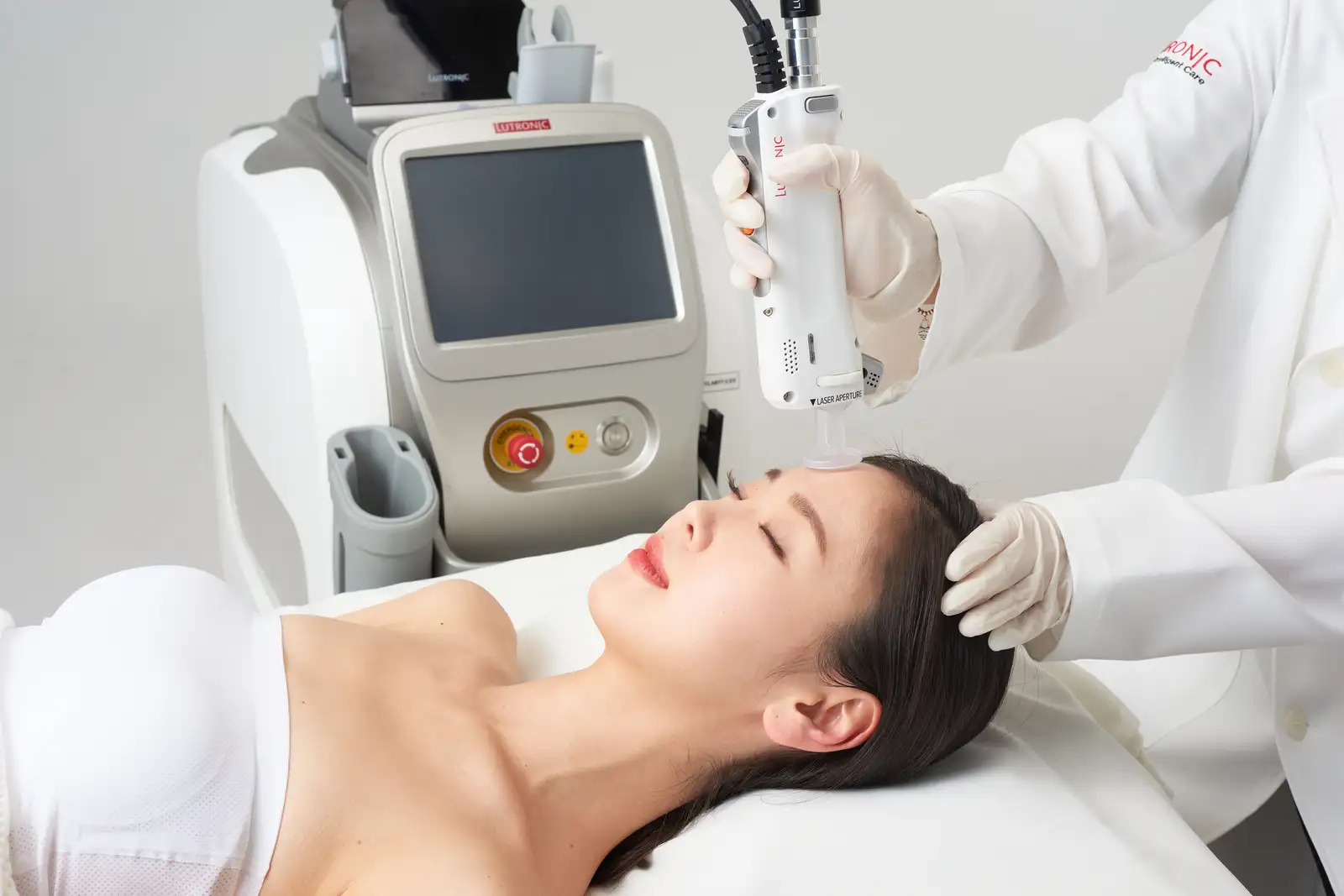
The name comes from the laser medium used: a chromium-doped chrysoberyl crystal, commonly known as Alexandrit. When optically pumped, this crystal emits light at 755 nm in the near-infrared range. The wavelength hits a point in the melanin absorption spectrum where absorption is high — higher than at 810 nm (diode) and significantly higher than at 1064 nm (Nd:YAG).
In practical terms, this means: for light to medium skin types (Fitzpatrick I–III) with dark to medium-dark hair, the energy is efficiently delivered to the hair root. The Alexandrit laser often works with relatively low fluence values here and can achieve good reduction rates per session.
Typical technical features:
- Wavelength 755 nm, pulsed in the millisecond range
- Spot sizes mostly 6–18 mm, depending on the device
- Fluence in the operating range of 10–30 J/cm²
- Pulse duration 3–40 ms
- Integrated contact or spray cooling, often supplemented by cold air
The diode laser between 800 and 810 nanometres
Diode lasers aren't created in a crystal medium, but in semiconductor diodes — similar to the laser diodes in Blu-ray players, just with significantly higher power and a defined wavelength. Medical diode lasers for hair removal mostly operate in the 800–810 nm range, though some device series also work at 755 nm, 940 nm, or as triple-wavelength hybrids (755/810/1064 nm).
The 810 nm wavelength is slightly further into the infrared spectrum than 755 nm. Melanin absorption is lower, and the penetration depth is slightly greater. This results in a very distinct characteristic:
- Generally, more energy needs to be used per pulse to achieve the same hair root heating as with Alexandrit.
- For very light skin types with dark hair, the efficiency falls short of Alexandrit — the active principle of selective photothermolysis doesn't take advantage of the higher melanin affinity at 755 nm here.
- With dark skin, the core problem remains: the epidermis still absorbs too much energy, which is why diode systems reach their limits there. Nd:YAG (1064 nm) is the objectively appropriate wavelength for Fitzpatrick V–VI — and we combine it in one device with Alexandrit.
Modern diode systems often work with high repetition rates and the In-Motion technique — which speeds up the process over large areas, but doesn't resolve the wavelength issue. You can find details on how this works in our laser methods guide; we ourselves use the stamp method on dual-laser platforms, not In-Motion diode systems.
| Feature | Alexandrite laser | Diode laser |
|---|---|---|
| Light source | Chrysoberyl crystal (Cr³⁺:BeAl₂O₄) | Semiconductor diode(s) |
| Typical wavelength | 755 nm | 800–810 nm (also 755/940/1064 nm as variants) |
| Melanin absorption | high | medium |
| Skin penetration depth | about 1.5–3 mm | about 2–3.5 mm |
| Typical fluence | 10–30 J/cm² | 20–60 J/cm² (depending on method) |
| Pulse duration | 3–40 ms | 5–400 ms (depending on device) |
| Common technique | Stamping technique | Stamp or gliding technique |
| Maintenance requirements | Crystal and flashlamp replacement at intervals | Diode module replacement at end of lifespan |
The role of Nd:YAG (1064 nm) in combined systems
If you take an objective look at Alexandrit and diode lasers, you can't ignore the Nd:YAG laser. 1064 nm is the wavelength with the lowest melanin absorption of the three — and at the same time, the one with the greatest penetration depth. It's used exactly where Alexandrit reaches its limits: on melanin-rich skin (Fitzpatrick IV–VI) and for deep-rooted, thick hair.
In modern premium platforms, Nd:YAG is usually combined with Alexandrit in a single device. The practitioner switches between wavelengths with a simple hand movement, without changing the machine — in practice, this is a significant advantage over pure diode systems when treating clients with different skin types. That's why we work with dual-laser platforms (Lutronic Clarity II and DEKA Again Pro) in our studios; find out more in our 2026 device comparison.
Chromophores: how melanin reacts to wavelengths
The crucial question is how strongly the target pigment melanin absorbs light at a given wavelength. Absorption drops continuously in the near-infrared range:
- 755 nm (Alexandrit): still high melanin absorption, relatively shallow penetration depth.
- 800–810 nm (Diode): medium absorption, slightly deeper penetration.
- 1064 nm (Nd:YAG): low melanin absorption, deepest penetration depth, protects the epidermis.
At the same time, water and haemoglobin also absorb in this wavelength range — with their own peaks. This is why pulse duration and fluence can't just be increased at will: beyond certain limits, blood vessels or deeper skin layers heat up too. That's why professional laser systems are calibrated and can be adjusted in a controlled way, and the people using them need to understand these dependencies. In Germany, this is regulated by the NiSV (Ordinance on Protection against Non-Ionising Radiation), which requires documented expertise to use such devices.
The three settings: fluence, pulse duration, spot size
Regardless of the wavelength, the effect of a laser pulse is determined by three parameters. They describe how the energy is delivered:
Modern devices allow these parameters to be combined within safe limits programmed into the medical device. In our clinic, we document the chosen values per session and treatment area in a treatment log — this allows for precise adjustments between sessions.
Direct technology comparison
A comparison is only helpful if it names the typical use cases where the differences become clear. There is no blanket 'better' or 'worse' with these two technologies.
| Scenario | Alexandrit 755 nm | Nd:YAG 1064 nm | Diode laser 810 nm |
|---|---|---|---|
| Light skin, dark hair (Fitzpatrick I–II) | proven choice — high efficiency | possible, rarely the first choice | works, less efficient than Alexandrit |
| Medium skin (III) | works well | preferable for tanned skin | wavelength-related compromise |
| Olive / lightly tanned (IV) | use with caution, adjust fluence | technically the right choice | epidermal stress remains relevant |
| Dark skin (V–VI) | not suitable | technically the right wavelength | not suitable |
| Large areas (legs, back) | efficient with a large spot size | works well on large areas | in-motion technique is fast, but the wavelength remains unfavourable |
| Fine facial hair | short pulses, good precision | in selected cases | less selective, more sessions needed |
The table makes it clear why the Alexandrit + Nd:YAG combination neatly covers the entire Fitzpatrick spectrum from I to VI: Alexandrit for light skin with high melanin affinity, Nd:YAG for darker skin with deep penetration. Which laser is right for you will be determined during a skin analysis; find out more in our laser selection by skin type guide.
How we combine Alexandrit and Nd:YAG at Laserazor
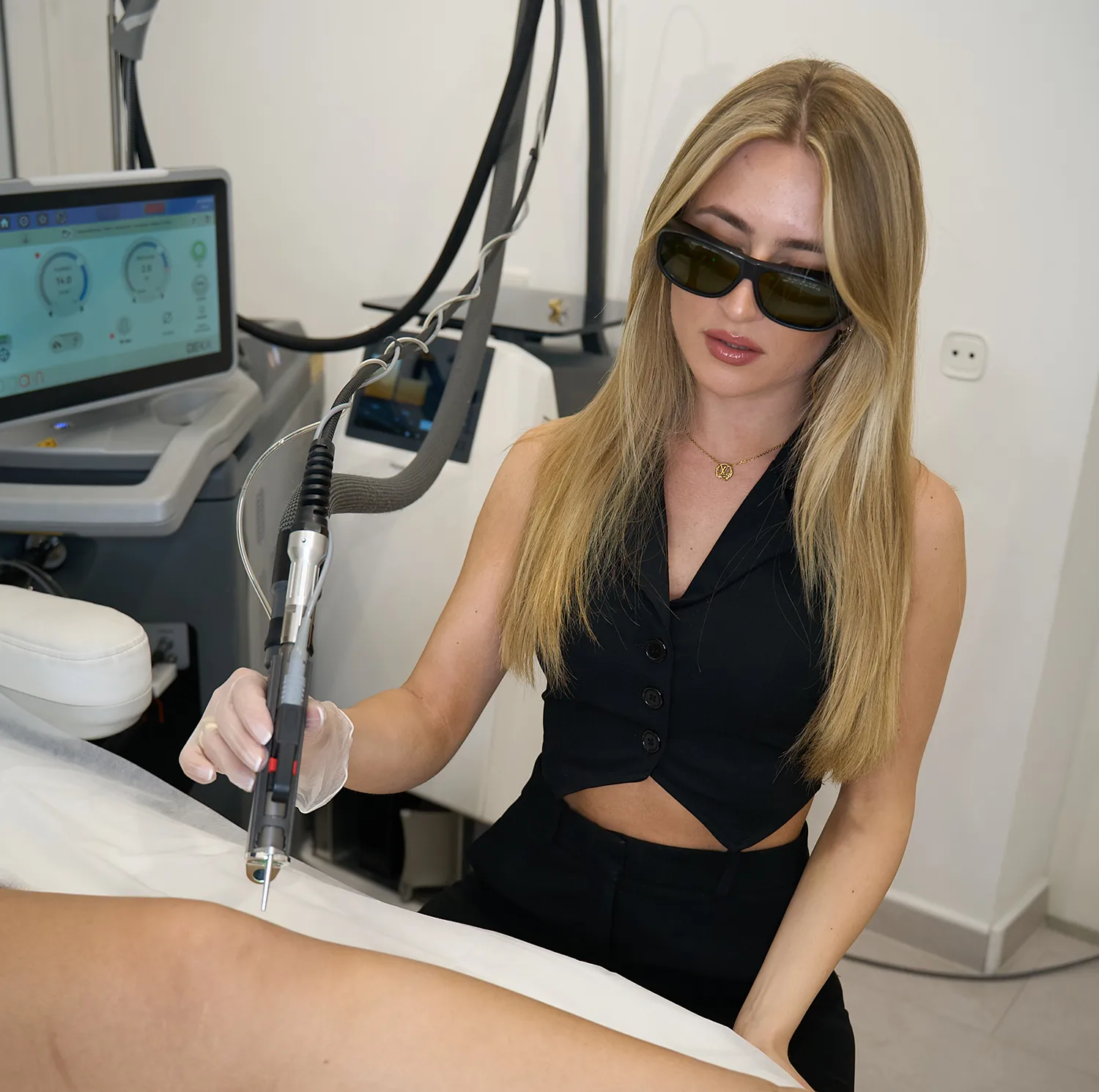
In our studios, we rely on two dual-laser platforms: the Lutronic Clarity II and the DEKA Again Pro. Both devices deliver Alexandrit (755 nm) and Nd:YAG (1064 nm) in one system. We deliberately avoid pure diode lasers — the Alexandrit + Nd:YAG combination covers the Fitzpatrick I to VI spectrum perfectly for everyday practice, and we can decide which wavelength is best per session and per treatment area.
Diode systems at 810 nm can treat fine hair on large areas, but they have their limits: they don't reliably cover the high melanin affinity for light skin (the Alexandrit domain) or the deep penetration for dark skin (the Nd:YAG domain). That's why we've made a conscious decision to rely exclusively on the dual Alexandrit + Nd:YAG combination — it's the technology that meets our premium standards.
Experience the difference yourself
During a free trial session, we'll show you the devices, perform a test pulse on a small zone, and have an honest chat about which wavelength suits your skin and hair type — with no obligation to book.


 Technology