

“Permanent¹” in legal terms means: long-term
When follicles are treated correctly, laser hair removal structurally destroys them so they generally don't grow back. A 100% lifelong removal of every single hair can't be scientifically guaranteed — hormonal changes can activate new follicles. A realistic expectation is 8–12 sessions for the initial treatment, plus 1–2 top-ups a year in hormonally sensitive areas.
What “permanent¹” means in a legal sense
The term “permanent” in laser hair removal advertising isn't used arbitrarily — it's defined by case law. The Higher Regional Court (OLG) Düsseldorf, in particular, has clarified in several rulings: “permanent” in this context must be interpreted as long-term. It shouldn't be confused with “forever and for every single hair”.
The industry-standard approach, which we also follow: every “permanent” claim on our website features a superscript ¹ linking to a footnote. This explains that we're talking about a long-term reduction, not a lifelong guarantee. This isn't hidden in the small print, but part of fair communication — and we actively point it out to you during your initial consultation.
How it works: why the anagen phase is crucial
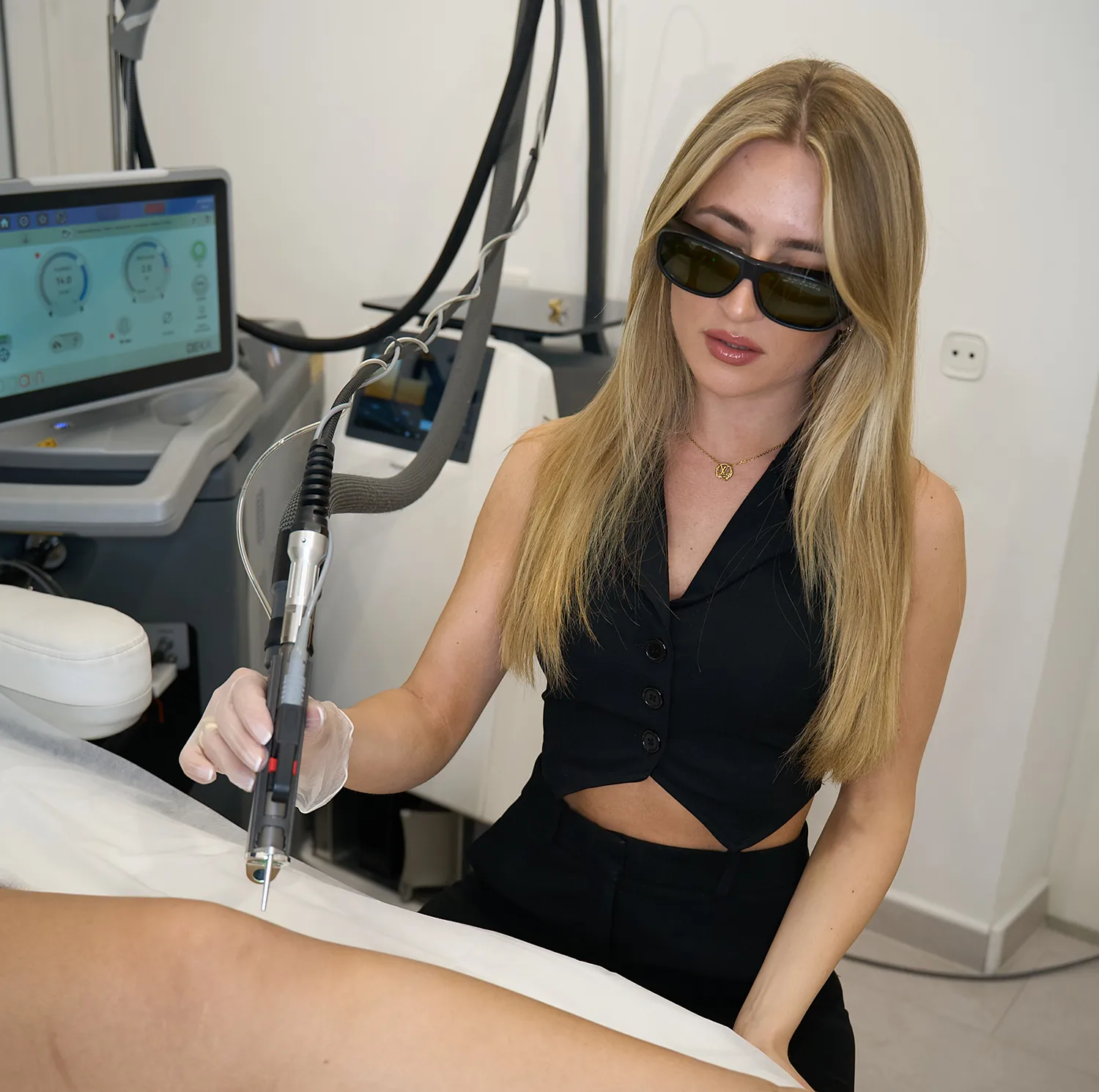
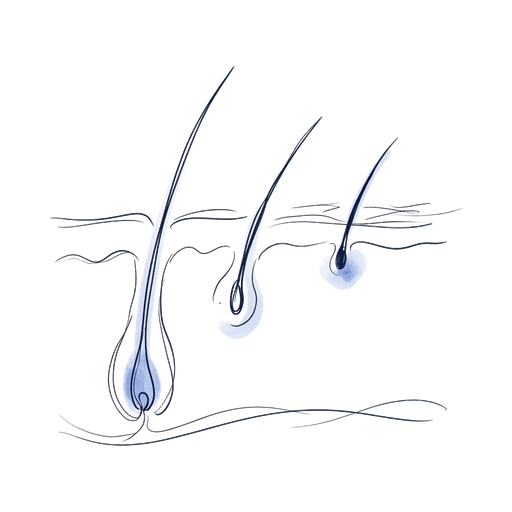
Every hair goes through a cycle of three phases:
- Anagen (growth phase): the hair is actively growing, and the hair matrix and stem cells are active. Only in this phase does the follicle respond to the laser pulse.
- Catagen (transitional phase): hair growth stops, and the root begins to shrink. Laser effectiveness is limited.
- Telogen (resting phase): the hair is shed later. No laser effect.
In any given zone, only 20–30 % of the hairs are in the anagen phase at any one time. That's why it takes multiple sessions spaced 4 to 8 weeks apart to target the follicles that will be in the active phase “at the next appointment”. This explains why a single session can never be enough — regardless of the device's power or the practitioner's experience.
What “reduction” actually means in numbers
In dermatological literature, successful laser hair reduction is defined as a permanent decrease in the number of hairs in the treated zone — measured after completing the initial treatment and a follow-up period of at least six months.
| Zone | Reduction after 8–12 sessions | Remaining fine hairs |
|---|---|---|
| Underarms | significant, stable | few, very fine |
| Legs | significant, stable | fine, patchy |
| Bikini / intimate area | significant, individual | fine to moderate, hormone-dependent |
| Face (cheeks, chin, upper lip) | significant, but hormone-dependent | new growth possible |
| Back / chest (men) | significant, stable | fine |
| Abdomen | significant, hormone-dependent | fine linea alba common |
These details describe our treatment range. We deliberately don't give fixed percentages — individual results depend heavily on your skin and hair type, hormone levels and treatment consistency.
Individual factors that affect your results
Hormones and new follicles — the most important 'fine print'
The most commonly overlooked point: treated and destroyed follicles usually don't grow back — but your body can activate new follicles that were dormant before your treatment. This typically happens during:
- Pregnancy and breastfeeding
- The start of the menopause or hormonal changes afterwards
- PCOS (polycystic ovary syndrome) and other endocrinopathies
- medications containing androgens or hormones
- hormone therapies as part of a gender transition
These hairs are not the same hairs that were removed before — they are new ones. That's why one top-up session a year makes sense for hormonally sensitive areas (face, stomach line, men's chests).
Top-up sessions — what's realistic
After finishing your initial treatment (typically 8–12 sessions), many clients plan one or two top-up appointments a year. The exact frequency depends on how hormonally active the area is:
| Zone | Typical top-up frequency |
|---|---|
| Underarms | every 12–18 months as needed |
| Legs | every 12–24 months as needed |
| Bikini / intimate area | every 9–15 months |
| Face (upper lip, chin) | every 6–12 months |
| Stomach line | every 9–12 months |
| Back / chest (men) | every 12–18 months |
The Laser-Flatrate is popular for this reason, among others: if you're getting regular top-ups anyway, a fixed monthly amount is often cheaper than individual sessions.
Realistic expectations — myth vs reality
| Claim | Realistic? |
|---|---|
| I'll be hair-free after the first session | No — initial reduction visible from session 2–3, significant reduction from session 4–5 |
| I need 3 sessions | Rarely — for most areas, 8–12 sessions are realistic |
| I will never have a hair in this area again | Unlikely — minor residual shedding and hormone-related reactivation possible |
| Long-term, significant reduction is achievable | Yes — with suitable skin/hair and consistent session planning |
| The result lasts for years | For many clients, yes¹ — with occasional top-ups |
| Grey hair can also be lasered | No — without melanin, the laser won't work |
| I can wax/epilate between sessions | No — this interrupts the cycle and affects the results. Shaving only. |
How we handle this at Laserazor
For us, transparent communication is the foundation of working with our clients. In practice, this means:
- In the initial consultation, we openly discuss the term "permanent¹" and the footnote logic.
- We estimate the expected number of sessions individually — without promising absolute numbers.
- We only recommend top-up appointments where they actually make sense.
- We document every session with parameters, practitioner, and observed reaction.
- We avoid statements like "hair-free forever" or "guaranteed permanent" — such phrases are legally vulnerable and factually inaccurate.
Honest advice instead of promises
In a free trial session, we assess your individual potential, determine your skin type, hair colour and zones, do a test pulse — and are completely open about the results you can expect.


 Results and sessions