The essentials at a glance
- The laser removes female facial hair permanently¹, as long as the hair has pigment; light peach fuzz, grey and white hairs hardly react.
- Upper lip, chin, cheeks and sideburns cost 37 € each, full face 70 €, calculated per session in a package of 10.
- 8 to 12 sessions spaced six to eight weeks apart, taking about 10 minutes per session for the upper lip.
- If you experience sudden heavy growth, get it medically checked first: hirsutism, PCOS, thyroid issues or medication.
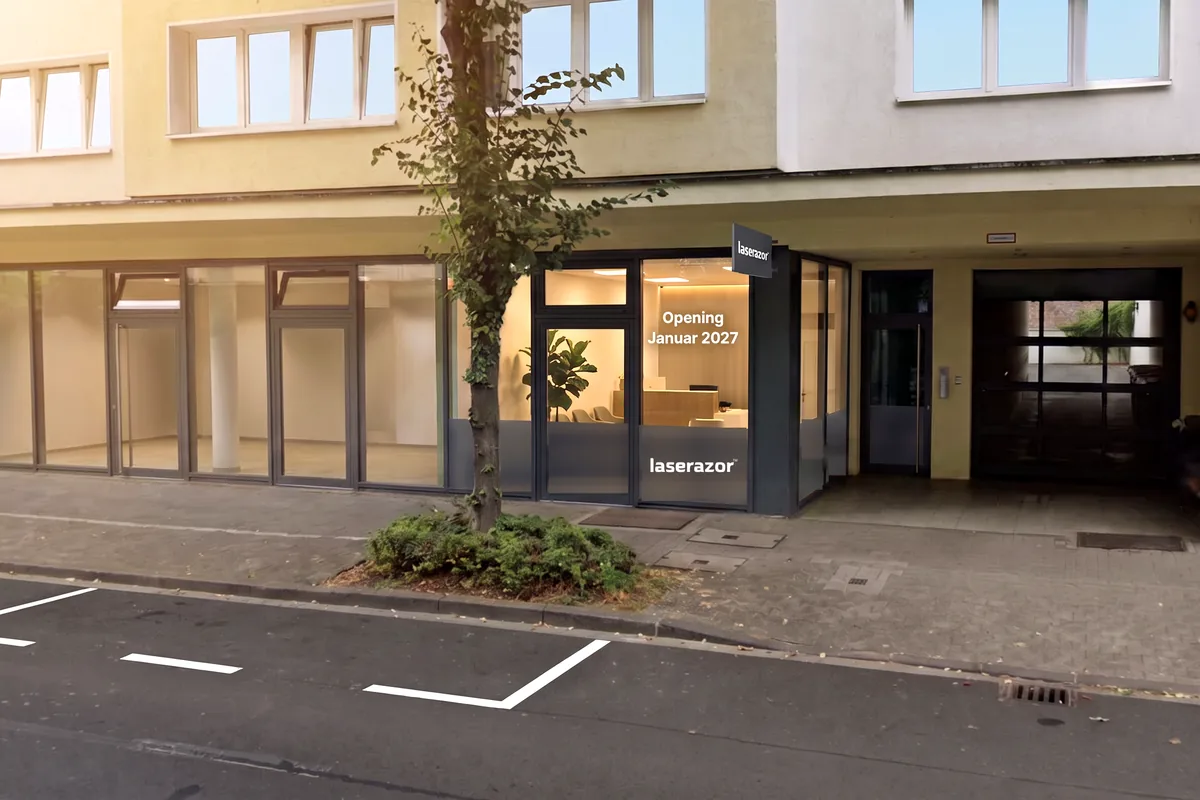
- Laserazor Düsseldorf opens in January 2027 in Unterbilk; until then, pre-register for your 0 € trial session.
Permanently removing female facial hair: the short answer
Female facial hair refers to visible, often dark hairs on the upper lip, chin, cheeks, sideburns or neck; it can be removed permanently¹ with a laser, as long as the hair has enough pigment.
For dark hairs, laser is the method that gets right to the root: 8 to 12 sessions spaced six to eight weeks apart, taking around 10 minutes per session for the upper lip. Light peach fuzz, grey and white hairs, however, barely respond or don't respond at all. And if your hair suddenly gets thicker, you should get the cause checked by a doctor first.
Laserazor is opening a studio in January 2027 at Elisabethstraße 30 in Düsseldorf-Unterbilk, just a five-minute walk from the south end of Königsallee. There, we treat using Alexandrit 755 nm and Nd:YAG 1064 nm, with cooling right before every pulse. Here you'll find out what the individual facial zones cost, which method works best for what, and where laser reaches its limits. For a general overview, check out the upper lip hair removal page.
Facial zones and what they cost
Facial hair rarely sticks to just one spot. It's usually most noticeable on the upper lip, often spreading to the chin or neck. At Laserazor, each area is a separate zone with a fixed price, which is the same across all our studios, including in Düsseldorf.
| Zone | Duration | 1 session | Pack of 3, per session | Pack of 5, per session | Pack of 10, per session |
|---|---|---|---|---|---|
| Upper Lip | 10 min | 59 € | 49 € | 39 € | 37 € |
| Chin | 10 min | 59 € | 49 € | 39 € | 37 € |
| Cheeks | 10 min | 59 € | 49 € | 39 € | 37 € |
| Sideburns | 10 min | 59 € | 49 € | 39 € | 37 € |
| Neck | 15 min | 59 € | 49 € | 39 € | 37 € |
| Full face | 20 min | 119 € | 97 € | 75 € | 70 € |
Excerpt from the price list featuring all 31 zones. Prices are per complete zone and are the same in all studios, including in Düsseldorf.
- Upper lip. The hairs here are often dark but fine, and the skin is sensitive. Find out more on the laser upper lip page.
- Chin. You'll often find individual thick, dark hairs here, which respond incredibly well to laser. If you have heavy growth on your chin, it's especially worth getting your hormones checked. Read more on the laser chin page.
- Cheeks. The hair here is usually finer. Laser is worth it if the hairs are dark, but it barely works on light peach fuzz.
- Sideburns. The transition to your head hair. Your specialist will agree the boundary with you beforehand to make sure your hairline looks natural.
- Neck. A separate zone taking around 15 minutes. This is ideal if your hair continues growing below the chin.
- Full face. Combines several areas like the upper lip, chin and cheeks into a single appointment taking around 20 minutes. Find out more on the face and head page.
Let's do the maths: Ten upper lip sessions in a 10-session package cost 370 €. Because that's over 300 €, you can pay for the course in 12 instalments at 0 %. If multiple areas bother you, the full face option is usually the better choice: 70 € per session in a 10-session package, whereas the upper lip, chin and cheeks booked separately would cost 111 € in total. Packages of 3, 5 or 10 sessions are valid for 24 months across all studios and reduce the price per session – by 20 to 45 percent for a 10-session package. You'll find all zones in the price list and in our guide Laser hair removal Düsseldorf: Prices.
Dark hairs, light hairs, peach fuzz: where laser works
Peach fuzz is the common name for the fine, short and light vellus hairs that grow almost everywhere on your skin. They have barely any pigment, which is why they hardly respond to laser treatment.
Laser works via the pigment in the hair. The light is absorbed there, converted into heat and damages the root – this is how Anderson and Parrish 1983 described the basic principle of all laser hair removal. The darker and thicker a hair is, the better it responds. Grey, white and light blonde hairs don't have any pigment to absorb the energy, while red hairs only respond partially.
| Facial hair | Laser effectiveness | Our advice |
|---|---|---|
| dark and coarse, like stray hairs on the chin | responds well | Laser course of 8 to 12 sessions |
| dark but fine, like on the upper lip | responds, often needs the upper end of the range | Course, check progress after each session |
| red | partially | Test pulses and an honest assessment after the first session |
| light blonde, grey or white | no effect | no laser, choose another method |
| light peach fuzz | hardly any effect | no laser, peach fuzz is a normal part of the skin |
For light and grey hair, electrolysis is usually a better option, where each hair is treated individually with an electric current. Laserazor doesn't offer this. During your trial session, we'll tell you honestly if the laser will work on your hair before you buy a package.
Alongside hair colour, your skin matters too. The six skin types according to Fitzpatrick 1988 determine the wavelength: Alexandrit for light to medium skin, Nd:YAG for dark and tanned skin. According to Ibrahimi and colleagues 2011, Nd:YAG is considered the safest choice for dark skin types. Even dark hairs on dark skin can be treated this way. Find out more in our guide Alexandrit or Nd:YAG.
Hormonal causes: get hirsutism and PCOS checked by a doctor
Hirsutism refers to increased hair growth in women following a male pattern, such as on the chin, upper lip, neck, chest or stomach; this is often driven by a stronger effect of male hormones.
A slight upper lip shadow is common and often genetic. During the menopause, the hairs on the upper lip and chin become thicker for many women. But if the hair becomes noticeably denser and thicker in a short time, there might be a hormonal cause behind it. The most well-known is polycystic ovary syndrome (PCOS), though the thyroid or medication can also play a role.
Please get this checked by a doctor, for example at your GP or gynaecologist, especially if you notice other signs: an irregular cycle, acne, hair loss on your head or hair on your chest and stomach. The laser treats the hair, not the cause. With hormonally driven growth, new hairs might appear after your course of treatments, meaning a top-up session is needed. We'll tell you this beforehand. Read more in our guide Hirsutism and hypertrichosis.
Comparing methods for the face
There are many ways to tackle upper lip hair. Most remove the hair at the surface or pull it out, only laser and IPL use light to target the root.
| Method | How it works | How long it stays smooth | For the face |
|---|---|---|---|
| Shaving | cuts the hair at the skin's surface | one to three days | quick, stubble soon noticeable, doesn't make hair thicker |
| Hair removal cream | chemically dissolves the hair at the surface | a few days | only facial products, can cause irritation |
| Threading | a twisted thread pulls the hair out by the root | around two to six weeks | precise, pulling pain, brief redness |
| Waxing | wax pulls the hair out by the root | around three to six weeks | irritates sensitive skin, ingrown hairs possible |
| Epilator | rotating tweezers pull the hair out | a few weeks | uncomfortable on the upper lip, ingrown hairs possible |
| IPL | flashlamp with a broad light spectrum heats the pigment | long-term, with many sessions | less targeted than a laser, less data available |
| Laser | Fixed-wavelength light damages the hair root | permanent¹ after 8 to 12 sessions | precise, only works on pigmented hair |
Important when switching to laser: threading, waxing, epilating and plucking remove the hair root that the laser needs to target. So, stop doing these four weeks before your first session and just shave instead. By the way, shaving doesn't make your hair thicker or darker, the blunt tip just makes it feel a bit coarser.
IPL uses a flashlamp instead of a fixed wavelength. The Cochrane review by Haedersdal and Gøtzsche 2006 found around 50 percent hair reduction for Alexandrit and diode lasers up to six months after treatment; the data for IPL was thinner at the time. You'll find a detailed comparison in our guide Permanent hair removal: methods compared and on the IPL hair removal page.
What to expect during your facial treatment
Treating a facial area is quick. Your first session at Laserazor is a 0 € trial session for one complete area, like the upper lip or chin.
- Consultation and skin type check. Our specialist will look at your skin and hair, and ask about any medications that make your skin sensitive to light, as well as skin conditions, sun exposure and hormonal factors. Afterwards, you'll get an honest assessment of whether the laser will work for you.
- Eye protection. Protecting your eyes is especially important during facial treatments. You'll wear suitable protective goggles throughout the session.
- Test pulses. A few test pulses show us how your skin and hair react. This helps us determine the right wavelength and energy.
- Treatment. The upper lip, chin, cheeks and sideburns take around 10 minutes each, while a full face takes about 20 minutes. The cooling system kicks in right before each pulse. You might feel the quick, warm pinch a bit more on your upper lip than on your chin.
- Right after. Mild redness for a few hours is completely normal. The Federal Office for Radiation Protection lists redness and, especially if the wrong energy level is used, pigmentation changes as possible side effects.
- The series. The treated hairs will fall out after two to three weeks. Your next session will be every six to eight weeks, with 8 to 12 sessions in total.
Care after and between your sessions
Your face is almost always exposed to light, making sun protection more important here than for any other area. By following a few simple rules, your skin will stay calm and your next session can go ahead right on schedule.
| When | What to do |
|---|---|
| on the day of treatment | no sports, no sauna, no sun, only mild, fragrance-free skincare |
| two weeks afterwards | SPF 50 on your face every day |
| after two to three weeks | the treated hairs will fall out, don't help them along with tweezers |
| between sessions | shaving is allowed, no plucking, no threading, no waxing |
| two weeks before the next session | no sun and no fake tan on your face |
| 12 to 24 hours before | shave the area, no cream on the area on the day itself |
You need to apply SPF 50 to your face every morning for two weeks, even on grey days. An afternoon on the Rheinwiesen without protection can push your next session back by two weeks. If you've just returned from holiday, mention it at your appointment so the specialist can choose the right wavelength or you can reschedule slightly.
Simply let the hairs that fall out after two to three weeks go. If you pluck them with tweezers, you're removing the root the laser needs for your next appointment. Shaving is allowed at any time between sessions. You can find more tips on the Preparation and aftercare page.
Upper lip laser hair removal at Laserazor Düsseldorf
The Laserazor Düsseldorf studio is located at Elisabethstraße 30, 40217 Düsseldorf, in the Unterbilk district on the border of Friedrichstadt. The Kirchplatz underground station on the Wehrhahnlinie is about 200 m away, and the southern end of the Königsallee is around 400 m away. Because treating the upper lip only takes about 10 minutes, your appointment will be quick. You can find out how to get to us from your district or the surrounding area in our guide Directions from districts and surrounding areas.
Treatments are carried out by specialists certified according to NiSV. Prices are the same as in all Laserazor studios, and purchased packages are valid for 24 months across all seven studios. We'll announce our opening hours before the launch. Until then, you can sign up in advance and test a facial zone in a 0 € trial session when we open. To find out more about what permanent hair removal in Düsseldorf involves, check out our guide Permanent hair removal in Düsseldorf.
Try female facial hair removal in Düsseldorf
Sign up and we'll invite you to our first appointments in January 2027. During your 0 € trial session, we'll treat one complete zone, such as your upper lip or chin. No purchase required, no subscriptions.
Frequently Asked Questions
Can female facial hair be permanently removed?
Yes, with a laser, as long as the hairs are dark enough. After 8 to 12 sessions spaced six to eight weeks apart, any hair the laser has successfully targeted won't grow back in the treated zone. Light blonde, grey, and white hairs, as well as light peach fuzz, barely respond or don't respond at all.
How much does laser hair removal for female facial hair cost in Düsseldorf?
At Laserazor Düsseldorf, the upper lip, chin, cheeks, and sideburns cost 59 € each for a single session, or 37 € per session in a 10-session package. The full face costs 119 € for a single session and 70 € per session in a 10-session package. Ten sessions for the upper lip therefore cost 370 €.
Does the laser work on light peach fuzz?
Barely. The laser needs pigment in the hair to absorb the energy, and peach fuzz has almost none. The same goes for light blonde, grey, and white hairs, while red hairs only respond partially. We'll give you an honest assessment during your trial session.
How many sessions do I need for my upper lip?
Usually 8 to 12 sessions spaced six to eight weeks apart. The hairs on the upper lip are often quite fine, so this zone tends to need the higher end of that range. Each session takes around 10 minutes.
When should I get female facial hair checked by a doctor?
If the hair suddenly becomes noticeably thicker or coarser in a short period of time, especially if accompanied by irregular periods, acne, hair loss on your head, or hair on your chest and stomach. This could be due to hirsutism, PCOS, thyroid issues, or medication. The laser only treats the hair itself, not the underlying cause.
Can I pluck or thread between sessions?
No. Plucking, threading, waxing and epilators remove the hair root, which the laser needs to target at your next appointment. Shaving is allowed between sessions. You should stop plucking four weeks before your first session.
Does laser on the upper lip hurt?
You'll feel a quick, warm pinch with each pulse, slightly more noticeable on the upper lip than on the chin or cheeks. The cooling right before each pulse takes away a lot of the heat, and the upper lip is done in about 10 minutes.
Is laser on the face possible for dark skin?
Yes. For dark and tanned skin, we use Nd:YAG with 1064 nm, which is considered the safest choice for dark skin types. For light to medium skin, we use Alexandrit with 755 nm. The specialist will determine the right wavelength after a skin type check and test pulses.
When can I start in Düsseldorf?
Laserazor Düsseldorf at Elisabethstraße 30 opens in January 2027, so online bookings aren't available just yet. You can join the waiting list now, and we'll invite you to the first appointments with a 0 € trial session. Our booking team can answer any questions at 030 310 13 860.
Sources
The expert statements in this guide are based on the following sources. For each source, you'll find who wrote it, when it was published and its status.
- Anderson RR, Parrish JA (1983). Selective photothermolysis: precise microsurgery by selective absorption of pulsed radiation. Science, Volume 220, pages 524 to 527. peer-reviewed article. View source. Describes the principle behind all laser hair removal: light of a suitable wavelength and pulse duration specifically heats pigmented structures, while the surrounding tissue remains unharmed.
- Fitzpatrick TB (1988). The validity and practicality of sun-reactive skin types I through VI. Archives of Dermatology, Volume 124, pages 869 to 871. peer-reviewed article. View source. Defines the six skin types based on their reaction to the sun, which remain the basis for choosing wavelength and energy today.
- Ibrahimi OA, Avram MM, Hanke CW, Kilmer SL, Anderson RR (2011). Laser hair removal. Dermatologic Therapy, Volume 24, pages 94 to 107. peer-reviewed review article. View source. Overview of mechanism of action, wavelengths (Alexandrit 755 nm, diode 800 to 810 nm, Nd:YAG 1064 nm), skin types, cooling and side effects; Nd:YAG is considered the safest choice for dark skin types.
- Haedersdal M, Gøtzsche PC (2006). Laser and photoepilation for unwanted hair growth. Cochrane Database of Systematic Reviews, Issue 4, CD004684. systematic review (Cochrane). View source. Evaluates randomised trials: Alexandrit and diode lasers show a hair reduction of around 50 percent up to six months after treatment; data for IPL and Nd:YAG was thinner at the time. Long-term data over years was missing in the evaluated studies.
- Bundesamt für Strahlenschutz (BfS) (continuously updated). Hair removal with laser and IPL: Information from the Federal Office for Radiation Protection. bfs.de, optical radiation section. Official information. View source. Explains the working principle and risks (redness, pigment changes, burns if the wrong energy is used) and recommends application by qualified professionals.
¹ 'Permanent' means: after a complete series, no hair that the laser has reached will grow back in the treated zone. No laser can reach grey, white and very light hairs. Hormonal changes can trigger new growth, in which case a top-up session is usually enough.

NiSV-certified specialists from the Laserazor studios in Berlin, München, Augsburg, Hamburg and Düsseldorf. They perform treatments daily with Alexandrit and Nd:YAG lasers and write down here what they explain in the studio: no marketing promises, with sources.
This guide provides general information and doesn't replace medical advice, diagnosis or treatment. Laser hair removal is a cosmetic procedure; if you have skin conditions, take medications that increase light sensitivity, are pregnant or have unexplained hair growth, it makes sense to get medical advice first.