The essentials at a glance
- Laser and electrolysis provide permanent¹ results; for larger areas, laser is the standard method, taking 8 to 12 sessions spaced six to eight weeks apart.
- Alexandrit 755 nm for light to medium skin, Nd:YAG 1064 nm for dark and tanned skin; grey, white, and light blonde hair do not respond.
- Prices per complete zone: underarms 48 €, full intimate 86 €, full legs 180 € per session in a 10-session package.
- Preparation: no waxing or epilating for four weeks, no sun for two weeks, shave 12 to 24 hours beforehand.
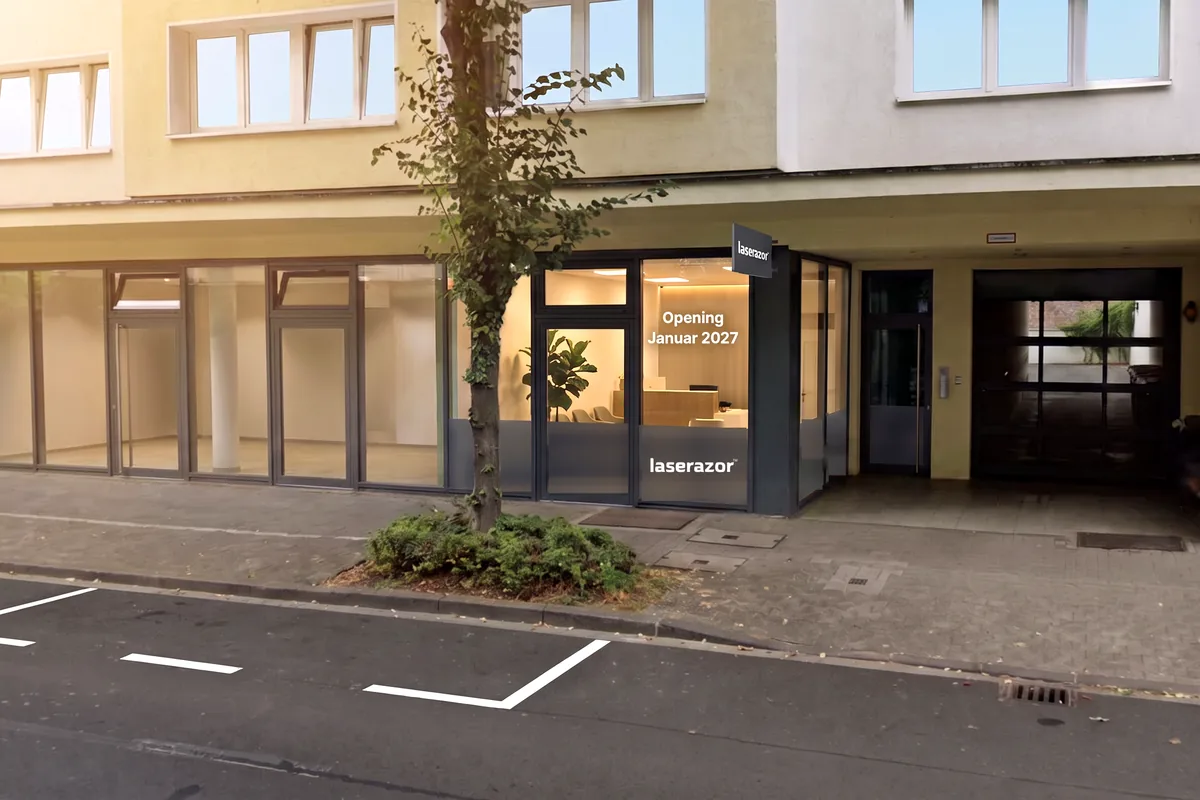
- Laserazor opens in January 2027 at Elisabethstraße 30, 40217 Düsseldorf, with a 0 € trial session for the launch.
Permanent hair removal in Düsseldorf: the short answer
Permanent¹ hair removal means: the hair root is damaged so that the hair no longer grows back. For areas like underarms, legs, or the back, a medical laser is the standard method, taking 8 to 12 sessions spaced six to eight weeks apart.
If you're looking for permanent hair removal in Düsseldorf, you'll find three types of providers. Dermatologists charge according to the medical fee schedule. Chains and beauty salons often use IPL or diode lasers and advertise prices for small areas. Studios using Alexandrit and Nd:YAG – two wavelengths for all skin types – are less common. Laserazor is opening a studio just like this in January 2027 at Elisabethstraße 30 in Düsseldorf-Unterbilk.
This guide explains how laser hair removal works, why it takes multiple sessions, which method suits which skin type, what a course of treatments costs, and how to spot a good studio. It's intentionally detailed so you can easily compare offers from other providers too.
| Question | Short answer |
|---|---|
| Which method? | medical laser, at Laserazor Alexandrit 755 nm and Nd:YAG 1064 nm |
| How many sessions? | 8 to 12 per area |
| What interval? | six to eight weeks, hairs fall out after two to three weeks |
| How long does a course take? | around one to one and a half years |
| For which skin types? | skin types I to VI, dark and tanned skin with Nd:YAG |
| What are the limits? | grey, white and light blonde hair don't react, red partially |
| How much does it cost? | Underarms 79 € individually, 48 € per session in a package of 10 |
| Where in Düsseldorf? | Laserazor, Elisabethstraße 30, 40217 Düsseldorf, from January 2027 |
How the laser works: selective photothermolysis
Selective photothermolysis is the principle behind all laser hair removal: a short pulse of light at a specific wavelength is absorbed by the pigment in the hair, converted into heat and damages the hair root, while the surrounding skin remains largely unharmed.
This principle was described by Anderson and Parrish 1983. The hair acts like a conductor: the melanin pigment in the hair shaft absorbs the light and carries the heat down to the root. For this to work, three settings need to be spot on. The wavelength determines how strongly the pigment absorbs the light and how deep it goes into the skin. The pulse duration determines how long the heat lasts. The energy determines how strongly the root is hit. Too little energy won't do anything, too much irritates the skin. That's why we do a patch test before every series.
| Light source | Wavelength | Strength | Skin types |
|---|---|---|---|
| Alexandrit laser | 755 nm | highly absorbed by the hair pigment | light to medium |
| Diode laser | around 800 to 810 nm | sits between Alexandrit and Nd:YAG | light to medium, depending on the device |
| Nd:YAG laser | 1064 nm | penetrates deeply, protects the pigmented epidermis | dark and tanned |
| IPL (flashlamp) | broad spectrum, filtered | not a laser, light scatters more | mainly fair with dark hair |
The review by Ibrahimi and colleagues 2011 describes the standard wavelengths and their strengths. Alexandrit at 755 nm is highly effective on fair to medium skin because the hair pigment absorbs this light particularly well. Nd:YAG at 1064 nm reaches deeper and is absorbed less by the pigment in the epidermis, making it the safest choice for dark skin. If you have both wavelengths, you don't have to turn anyone away because of their skin colour. Our guide Alexandrit or Nd:YAG compares this in detail.
Cooling the skin right before each pulse protects the epidermis and makes the treatment more comfortable. In all Laserazor studios, including in Düsseldorf, this is part of every treatment.
Hair cycle: why a course takes 8 to 12 sessions
A zone needs 8 to 12 sessions because the laser only permanently targets hair in the growth phase, and only a fraction of your hair is growing at any one time. Every hair goes through three phases. In the growth phase, it sits deep and is firmly attached to the pigmented root, allowing the heat to reach exactly the right spot. In the transitional phase, the root detaches, and in the resting phase, the hair is just sitting loosely and will eventually fall out.
After each session, the targeted hairs fall out after two to three weeks. Six to eight weeks later, the next group is in the growth phase and gets treated. This is how the course works its way through all the hairs in a zone, step by step. The review by Gan and Graber 2013 confirms the role of the hair cycle in the number of sessions. For Alexandrit and diode lasers, the Cochrane review by Haedersdal and Gøtzsche 2006 found around 50 percent hair reduction up to six months after treatment. Long-term data over many years was missing in the evaluated studies – that's also part of an honest answer.
| Timing | What happens |
|---|---|
| Trial session | Skin type check, test pulses, a complete zone is treated |
| two to three weeks later | the treated hairs loosen and fall out |
| after six to eight weeks | the next group of hairs is in the growth phase, next session |
| over the course of the series | gradually, fewer hairs grow back |
| after 8 to 12 sessions | the zone is permanently¹ hair-free, after about one to one and a half years |
| later | a top-up may be needed in case of hormonal changes |
Leaving too little time between sessions doesn't help, because no new hairs will be in the growth phase yet. Pauses that are too long will extend your series, but they won't do any harm. Underarms and the bikini zone often respond faster, while legs and backs tend to need the upper end of the range. Whether your hair growth is hormonally influenced also plays a role – there's more on this in the safety section.
Skin types and hair colours: what can be treated
Using two wavelengths, we can treat all six skin types according to Fitzpatrick 1988: Alexandrit for light to medium skin, and Nd:YAG for dark and tanned skin. The scale describes how your skin reacts to the sun, from type I, which always burns, to type VI, which is very dark skin. This is important for the laser because the pigment in your skin competes with the pigment in your hair for the energy.
| Skin type | Typical | Wavelength at Laserazor |
|---|---|---|
| I and II | very fair to fair skin, rarely tans | Alexandrit 755 nm |
| III | medium skin, tans slowly | Alexandrit 755 nm |
| IV | olive skin, tans easily | Alexandrit or Nd:YAG, after test pulses |
| V and VI | dark to very dark skin | Nd:YAG 1064 nm |
| tanned | any type after sun exposure | Nd:YAG 1064 nm, let fresh tans fade first |
The limit is the hair, not the skin. Grey, white and light blonde hair has too little pigment and won't respond to any laser. Red hair responds partially. The darker and thicker the hair, the better it absorbs the energy. For individual light or grey hairs, electrolysis is the way to go – more on that in a moment. You can find out more about skin and hair under Skin and hair, and how to choose the right wavelength for your skin type in our guide Choosing a laser by skin type.
Laser, IPL, diode, waxing and electrolysis compared
Laser and electrolysis offer permanent¹ results, whereas waxing and shaving only remove hair for weeks or days. IPL sits somewhere in between – it can reduce hair, but it isn't a laser and has weaker backing in studies. The table shows the differences, followed by the key points for each method.
| Method | How it works | How long it lasts | Suitable for |
|---|---|---|---|
| Laser (Alexandrit, Nd:YAG) | one wavelength heats the hair pigment and damages the root | permanent¹ after 8 to 12 sessions | all skin types, pigmented hair, large and small areas |
| Diode laser | one wavelength around 800 nm, same principle | long-term reduction after a series | light to medium skin, depending on the device |
| IPL | filtered flash light with multiple wavelengths | reduction, less clinical data than for Alexandrit and diode | light skin with dark hair |
| Electroepilation | fine probe in every single follicle, current destroys the root | permanent for each treated hair | individual hairs, including grey and white |
| Waxing, sugaring | hair is pulled out by the root | a few weeks, then it grows back | any skin type, must be repeated regularly |
| shaving, cream | Hair is removed at the surface | a few days | any skin type, short-term |
Laser with Alexandrit and Nd:YAG
A laser emits a concentrated beam of light at a single wavelength. This makes it precise and predictable. With two wavelengths, it covers all skin types and treats small areas like the upper lip just as well as the entire body. This is the method we use in all our studios.
Diode laser
The diode laser operates at a wavelength of around 800 nm, placing it between Alexandrit and Nd:YAG. The effectiveness of Alexandrit and diode lasers is best supported by studies. For very dark skin, its safety and effectiveness depend on the device. Many chains and beauty salons work with diode lasers or IPL.
IPL
IPL is a flashlamp. Its broad spectrum of light is filtered and scatters more in the skin than a laser beam. For light skin with dark hair, this can significantly reduce hair growth. However, the Cochrane review found less data supporting IPL at the time compared to Alexandrit and diode. Find out more under IPL hair removal.
Electroepilation
With electrolysis, a specialist inserts a fine probe into each individual hair follicle and destroys the root with an electric current. This also works on grey and white hair because it doesn't need pigment. However, it takes a long time because each hair is treated individually. It makes sense for shaping eyebrows or treating a few light hairs on the chin, but not for legs or backs.
Waxing and sugaring
Wax and sugar paste pull the hair out by the root. The result lasts for a few weeks, then the hair grows back and it starts all over again. If you want laser treatment, you have to stop doing this four weeks beforehand because the laser needs the root in the follicle. Calculated over years, waxing is usually the most expensive solution; you can find the cost comparison in our guide Laser hair removal Düsseldorf: Prices. You can find a detailed comparison of methods under Permanent hair removal: Methods compared.
What permanent hair removal costs in Düsseldorf
At Laserazor in Düsseldorf, underarms cost 48 € per session in a package of 10, so a complete series of ten sessions is 480 €. The prices apply per complete area and are the same in all studios. In a package of 3, 5 or 10 sessions, the price per session drops – by 20 to 45 percent in a 10-session package; each package is valid for 24 months.
| Zone | Duration | 1 session | Pack of 3, per session | Pack of 5, per session | Pack of 10, per session |
|---|---|---|---|---|---|
| Upper Lip | 10 min | 59 € | 49 € | 39 € | 37 € |
| Full face | 20 min | 119 € | 97 € | 75 € | 70 € |
| Underarms | 10 min | 79 € | 65 € | 51 € | 48 € |
| Bikini Area | 10 min | 99 € | 81 € | 63 € | 59 € |
| Full intimate area (women) | 15 min | 149 € | 121 € | 93 € | 86 € |
| Calves | 30 min | 179 € | 145 € | 111 € | 103 € |
| Full Legs | 45 min | 319 € | 257 € | 195 € | 180 € |
| Full Back | 40 min | 269 € | 217 € | 165 € | 152 € |
| Full Body | 180 Min | 659 € | 609 € | 559 € | 519 € |
Excerpt from the price list featuring all 31 zones. Prices are per complete zone and are the same in all studios, including in Düsseldorf.
For comparison: dermatology clinics charge according to the medical fee schedule, usually around 90 to 150 € per session for underarms, often without a package discount. From a total price of 300 €, you can pay with us in 12 instalments at 0 %, and as a monthly solution we offer the VIP flat rate from 109 € a month. Combo packages, calculation examples for entire series, and what makes a fair price can be found in our guide Laser hair removal Düsseldorf: Prices.
The process: from the trial session to the final session
Every series starts with a 0 € trial session, which includes a skin type check, test pulses, and one complete area. After that, you have a session every six to eight weeks until the area is finished.
- Consultation. The specialist asks about medication, skin conditions, sun exposure and previous treatments, and determines your skin type.
- Test pulses. A few pulses on a small area show how your skin and hair react. This determines the wavelength and energy.
- Treatment. Wearing protective goggles, pulse by pulse across the entire zone, with cooling immediately before each pulse. Underarms take ten minutes, full intimate area 15, full back 40, full legs 45 and full body 180 minutes.
- Afterwards. Mild redness for a few hours is normal. No sports, sauna or sun on the day of your treatment.
- Series. The next session takes place after six to eight weeks. If needed, the specialist will adjust the energy.

How the treatment feels depends on the zone and hair. It usually feels like a quick, warm pinch per pulse. It's milder on the legs and arms, and more noticeable in the intimate area and on the upper lip. The cooling absorbs a large part of the heat. Find out more in our guide to low-pain laser hair removal.
Preparation and aftercare
The most important rule is: no waxing, epilating or plucking for four weeks before your session, and no sun on the zone for two weeks beforehand. Everything else is simple and listed in the table, along with the reason why.
| When | What | Why |
|---|---|---|
| four weeks before | no waxing, epilating or plucking | the laser needs the hair with its root in the follicle |
| two weeks before | no sun, sunbeds or fake tan on the zone | otherwise pigment in the skin absorbs the energy |
| 12 to 24 hours before | shave the zone | otherwise hair above the skin absorbs energy and irritates the skin |
| on the day of treatment | no cream or deodorant on the zone | residue can irritate the skin |
| later that same day | no sport, no sauna, no sun | your skin is warm and slightly red |
| two weeks afterwards | SPF 50 on the zone | helps prevent pigmentation changes |
In Düsseldorf, this mainly means factoring in summer by the Rhine, at the outdoor pool, or on holiday. Schedule your appointments so that the zone gets no direct sun for two weeks before and after each session, or protect it strictly. If you start in January, you'll have three to four sessions done by summer. You can shave whenever you like between sessions. You'll find the detailed guide under Preparation and aftercare.
Safety, side effects, and when to see a doctor first
With the right energy and cooling, side effects are mild: redness and slight swelling around the follicles, which fade after a few hours. The Federal Office for Radiation Protection lists redness, pigmentation changes, and burns from incorrect energy settings as risks, and recommends treatment by qualified professionals. That's exactly why the NiSV has made specialist certification mandatory for anyone using laser or IPL for hair removal since 31.12.2020.
Tattoos and dark moles are bypassed because their pigment also absorbs the light. You should check with a doctor first if you have: skin conditions in the zone, medications that make your skin light-sensitive, pregnancy, or sudden heavy hair growth (e.g., suspected PCOS). Hormonal hair growth can be treated with laser, but a few new hairs might appear after your sessions. Our guide Dermatologist or laser studio in Düsseldorf explains when a dermatologist is the better choice, and you can find the background on heavy hair growth in our guide Hirsutism and hypertrichosis.
Zones: from the upper lip to the back
Laserazor treats 31 zones, from the upper lip, underarms, intimate area, and legs, right through to the back and full body. Every zone has its own quirks, which is why we have dedicated guides for them.
- Face: The upper lip is 37 €, chin 37 €, and cheeks 37 € per session in a package of 10. The laser does reach its limits with fine, light peach fuzz. Find out more in our guide Permanent facial hair removal for women in Düsseldorf.
- Intimate area: Full intimate takes 15 minutes and costs 86 € per session in a package of 10. You can find out exactly what this zone includes and what to look out for in our guide Laser hair removal for the intimate area in Düsseldorf.
- Men: The back, chest, shoulders, and neck are large areas with thick hair that responds really well to treatment. Read more in our guide Laser hair removal for men in Düsseldorf.
- Large areas: Full legs take 45 minutes, and a full body takes 180 minutes. You can find all zones under All zones.
How to spot a good laser studio in Düsseldorf
A good laser studio tells you the wavelength of their laser, employs specialists with NiSV certification, does a skin type check with test pulses before your first session, and gives you fixed prices per complete area with package durations.
- Wavelengths instead of buzzwords: Alexandrit 755 nm, diode around 800 nm, Nd:YAG 1064 nm. If they don't give you a number, they're often using IPL.
- Two wavelengths: It's the only way to treat light, dark, and tanned skin equally well.
- NiSV certification: Ask to see the credentials of the person treating you.
- Cooling before every pulse: protects the skin and should be standard practice.
- Fixed prices per complete area: no "starting from" prices for half an underarm or a few square centimetres.
- Trial treatment: Test pulses and a complete area before you buy a package.
- Honest limits: A reputable studio will tell you upfront that grey, white, and light blonde hair won't respond to any laser.
You can find the detailed checklist with questions for your initial consultation in our guide Best laser hair removal in Düsseldorf.
Laserazor in Unterbilk: the studio from January 2027
From January 2027, Laserazor will be offering permanent¹ hair removal at Elisabethstraße 30, 40217 Düsseldorf, about 200 m from Kirchplatz underground station and about 400 m from the south end of Königsallee. From the Hauptbahnhof, take tram 708 or 709 to Graf-Adolf-Platz and walk for about five minutes. It's about a 15-minute walk from the Medienhafen.
In the studio, we work with Alexandrit 755 nm and Nd:YAG 1064 nm, with cooling before every pulse, and with specialists who have NiSV certification. The prices are the same as in Berlin, München, Augsburg, and Hamburg, and every package is valid in all seven studios. For Köln, Bonn, the Ruhrgebiet, and the Niederrhein, Düsseldorf is the nearest Laserazor studio; you can find directions in our guide Directions from districts and the surrounding area. You can find out what's planned for the opening in the announcement Laserazor opens in Düsseldorf in January 2027.
Sign up for the Düsseldorf opening
Sign up and we'll invite you to the first appointments in January 2027, with a 0 € trial session for a complete zone. No purchase, no subscription.
Frequently Asked Questions
How much does permanent hair removal cost in Düsseldorf?
At Laserazor Düsseldorf, underarms cost 79 € for a single session and 48 € per session in a 10-session package, full intimate area 86 €, full legs 180 €, and full back 152 € per session in a 10-session package. A series of ten underarm sessions therefore costs 480 €. Dermatology clinics usually charge around 90 to 150 € per session for underarms.
Is laser hair removal really permanent?
Yes, for the hair the laser can target. After 8 to 12 sessions, it won't grow back in the treated area. No laser can pick up grey, white, or light blonde hair. Hormonal changes might trigger new growth later on, but a quick top-up session is usually all you need.
How many sessions will I need for one area?
Usually 8 to 12 sessions spaced six to eight weeks apart, which takes about a year to a year and a half. The laser only targets hair in the active growth phase, which is only ever a percentage of your hair. Underarms and the bikini area often respond faster, while legs and backs tend to need the higher number of sessions.
Laser or IPL: which is better for permanent hair removal?
For permanent results, laser is the better choice. It uses a single, focused, and predictable wavelength, and with Alexandrit and Nd:YAG, it works for all skin types. IPL is a filtered flashlamp with more scattered light; the 2006 Cochrane review found less robust data for IPL compared to Alexandrit and diode lasers.
Can I get laser hair removal if I have dark skin?
Yes. We use the Nd:YAG laser at 1064 nm to treat skin types IV to VI and tanned skin, as it safely bypasses the pigmented top layer of the skin. For type IV, we use test pulses to decide between Alexandrit and Nd:YAG.
Does laser work on blonde, red, or grey hair?
Grey, white, and light blonde hair won't respond to any laser because they lack pigment. Red hair responds to some extent. For individual light or grey hairs, electrolysis is a great alternative, as it treats each hair individually with a tiny electrical current.
How do I prepare for laser hair removal?
No waxing, epilating, or plucking for four weeks beforehand. Keep the area out of the sun and avoid fake tan for two weeks prior, and shave 12 to 24 hours before your appointment. On the day of your treatment, don't apply any creams or deodorant to the area. Afterwards, avoid workouts, saunas, and sun exposure for the rest of the day.
Does laser hair removal hurt?
You'll feel a quick, warm pinch with each pulse. It's very mild on the legs and arms, but a bit more noticeable on the upper lip and intimate areas. The built-in cooling right before each pulse takes away most of the heat.
When and where does Laserazor offer permanent hair removal in Düsseldorf?
From January 2027 at Elisabethstraße 30 in Düsseldorf-Unterbilk, about 200 m from the Kirchplatz underground station. You can't book online just yet, but you can join the waitlist at laserazor.de/standorte/duesseldorf. To celebrate our opening, we're offering a 0 € trial session for one complete area.
Do I need a dermatologist for laser hair removal?
Not if your skin is healthy. Specialists with NiSV certification are allowed to remove hair with lasers. You should see a dermatologist beforehand if you have skin conditions in the area, are taking photosensitising medication, are pregnant, or experience sudden heavy hair growth, for example, if PCOS is suspected.
Sources
The expert statements in this guide are based on the following sources. For each source, you'll find who wrote it, when it was published and its status.
- Anderson RR, Parrish JA (1983). Selective photothermolysis: precise microsurgery by selective absorption of pulsed radiation. Science, Volume 220, pages 524 to 527. peer-reviewed article. View source. Describes the principle behind all laser hair removal: light of a suitable wavelength and pulse duration specifically heats pigmented structures, while the surrounding tissue remains unharmed.
- Ibrahimi OA, Avram MM, Hanke CW, Kilmer SL, Anderson RR (2011). Laser hair removal. Dermatologic Therapy, Volume 24, pages 94 to 107. peer-reviewed review article. View source. Overview of mechanism of action, wavelengths (Alexandrit 755 nm, diode 800 to 810 nm, Nd:YAG 1064 nm), skin types, cooling and side effects; Nd:YAG is considered the safest choice for dark skin types.
- Gan SD, Graber EM (2013). Laser hair removal: a review. Dermatologic Surgery, Volume 39, pages 823 to 838. peer-reviewed review article. View source. Summarises research, side effects and treatment parameters; confirms the role of the hair cycle for the number of sessions.
- Haedersdal M, Gøtzsche PC (2006). Laser and photoepilation for unwanted hair growth. Cochrane Database of Systematic Reviews, Issue 4, CD004684. systematic review (Cochrane). View source. Evaluates randomised trials: Alexandrit and diode lasers show a hair reduction of around 50 percent up to six months after treatment; data for IPL and Nd:YAG was thinner at the time. Long-term data over years was missing in the evaluated studies.
- Fitzpatrick TB (1988). The validity and practicality of sun-reactive skin types I through VI. Archives of Dermatology, Volume 124, pages 869 to 871. peer-reviewed article. View source. Defines the six skin types based on their reaction to the sun, which remain the basis for choosing wavelength and energy today.
- Bundesamt für Strahlenschutz (BfS) (continuously updated). Hair removal with laser and IPL: Information from the Federal Office for Radiation Protection. bfs.de, optical radiation section. Official information. View source. Explains the working principle and risks (redness, pigment changes, burns if the wrong energy is used) and recommends application by qualified professionals.
- Federal Government (Regulation) (2018, in effect since 31.12.2020). Ordinance on Protection against the Harmful Effects of Non-Ionising Radiation in Human Applications (NiSV). Federal Law Gazette 2018 Part I, page 2034. statutory order. View source. Regulates who is allowed to use lasers and IPL on humans. For hair removal, proven expertise is mandatory; treatments that intentionally damage tissue are reserved for doctors.
- Laserazor (as of 9. September 2026). Laser hair removal price list, all 31 zones. laserazor.de/preise. own price list. View source. Single sessions and packages of 3, 5 and 10 sessions, valid in all studios, 24-month duration.
¹ 'Permanent' means: after a complete series, no hair that the laser has reached will grow back in the treated zone. No laser can reach grey, white and very light hairs. Hormonal changes can trigger new growth, in which case a top-up session is usually enough.

NiSV-certified specialists from the Laserazor studios in Berlin, München, Augsburg, Hamburg and Düsseldorf. They perform treatments daily with Alexandrit and Nd:YAG lasers and write down here what they explain in the studio: no marketing promises, with sources.
This guide provides general information and doesn't replace medical advice, diagnosis or treatment. Laser hair removal is a cosmetic procedure; if you have skin conditions, take medications that increase light sensitivity, are pregnant or have unexplained hair growth, it makes sense to get medical advice first.