The essentials at a glance
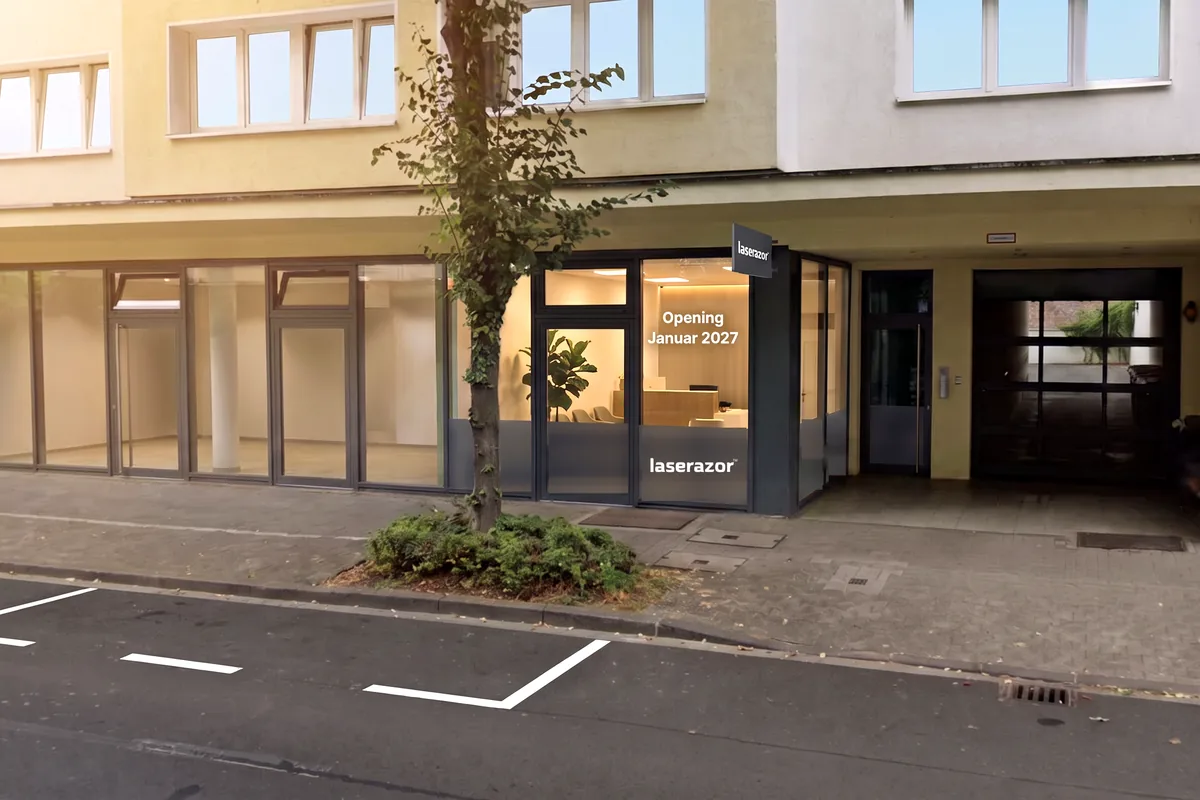
- Laserazor has no studio in Köln. The nearest one opens in January 2027 in Düsseldorf, Elisabethstraße 30 in Unterbilk.
- From Köln Hbf, take the RE1, RE5 or ICE for 22 to 30 minutes to Düsseldorf Hbf, then it's just a few minutes on the 708 or 709 tram.
- Good laser hair removal means: a specified wavelength, expertise according to NiSV, cooling before every pulse, a skin type check and test pulses.
- A course consists of 8 to 12 sessions, which means eight to twelve trips from Köln. Underarms cost 48 € per session in a package of 10.
- Until the opening, you can join the waitlist and receive an invitation for a 0 € trial session for a complete area.
Laser hair removal in Köln: the honest answer first
Laserazor doesn't have a studio in Köln. The nearest Laserazor studio opens in January 2027 in Düsseldorf, at Elisabethstraße 30 in Unterbilk. From Köln Hbf, it takes 22 to 30 minutes on the RE1, RE5 or ICE to Düsseldorf Hbf, then it's just a few minutes by tram to Graf-Adolf-Platz and about a five-minute walk.
If you're planning permanent¹ laser hair removal in Köln, this guide will help you choose, whether you end up getting treated in Köln or Düsseldorf. If a provider in your neighbourhood meets all the criteria, they're a good choice. If not, Düsseldorf is your nearest Laserazor location.
| Question | Answer |
|---|---|
| Laserazor studio in Köln | none |
| Nearest Laserazor studio | Laserazor Düsseldorf, Elisabethstraße 30, 40217 Düsseldorf (Unterbilk) |
| Opening | January 2027, join the waiting list until then |
| Train from Köln Hbf | RE1, RE5 or ICE to Düsseldorf Hbf, 22 to 30 minutes, faster on the ICE |
| Onward from Düsseldorf Hbf | Tram 708 or 709 to Graf-Adolf-Platz, then about a five-minute walk |
| Car from Köln city centre | around 40 to 50 minutes via the A57 or A3, without traffic |
| Parking | Friedrichstraße underground car park (around 150 m) and Talstraße car park (around 300 m), both paid parking |
| Technology | Alexandrit 755 nm and Nd:YAG 1064 nm, cooling immediately before each pulse |
What makes for good laser hair removal
Laser hair removal is a process where light of a specific wavelength is absorbed by the pigment in the hair and converted into heat, damaging the hair root so the hair stops growing back.
The principle is called selective photothermolysis and was described by Anderson and Parrish in 1983. The light is meant to specifically heat the hair while protecting the surrounding skin. Whether this works depends on three key factors: wavelength, energy, and cooling. A good treatment tailors all three to your skin and hair. A bad one uses a one-size-fits-all setting.
Five things separate good treatments from mediocre ones:
- A specific wavelength. Alexandrit works at 755 nm, Nd:YAG at 1064 nm, and diode lasers at 800 to 810 nm (Ibrahimi et al. 2011). Anyone who just talks about 'light technology' is often using IPL, a flashlamp without a fixed wavelength.
- NiSV certification. Since 31 December 2020, anyone removing hair with a laser or IPL needs specialist certification under the NiSV.
- Cooling before each pulse. This protects the epidermis and makes the treatment more comfortable.
- Skin type check and test pulses. Before the first session, not just when the skin is already irritated.
- A realistic number of sessions. A reputable estimate is 8 to 12 sessions, spaced six to eight weeks apart. The reason is the hair growth cycle: the laser only targets hairs in the active growth phase, while the rest are treated in later sessions (Gan and Graber 2013).
After each session, the treated hairs fall out within two to three weeks. What the research says: The Cochrane review by Haedersdal and Gøtzsche 2006 found around a 50 percent hair reduction up to six months after treatment for Alexandrit and diode lasers. Long-term data over several years was missing from the evaluated studies. That's why a trustworthy provider explains the word 'permanent' instead of selling it as a guarantee. You can find out more about the tech under Technology.
Skin types in a diverse city
Skin type describes, according to Fitzpatrick, how your skin reacts to the sun, from Type I, which always burns, to Type VI with very dark skin, and it determines which wavelength is safe and effective.
With around 1.1 million residents, Köln is the largest city in NRW (IT.NRW). In a city like this, people with all six skin types visit a laser studio. This is exactly where many places fail: a device designed for light skin with dark hair doesn't automatically suit olive, brown, or very dark skin.
The rule of thumb is: Alexandrit at 755 nm is the efficient choice for light to medium skin, while Nd:YAG at 1064 nm is the safer option for dark and tanned skin (Ibrahimi et al. 2011). The longer-wavelength light is absorbed less by the pigment in the epidermis. A studio with both wavelengths can treat any skin type. Still, the same applies to everyone: no sun and no fake tan on the treatment area for two weeks before each session.
The second limit is hair colour, not skin. Grey, white and light blonde hair won't respond to any laser, and red hair only partially. If you have mostly light or grey hair, you're better off with electrolysis. You can find a comparison of all methods in our guide Permanent hair removal in Köln, and how to choose the right wavelength in the guide Alexandrit or Nd:YAG.
How to compare providers in Köln
In Köln, you'll come across three types of providers, and each bills differently. Once you know the differences, you'll stop comparing promotional prices and start comparing actual services.
| Provider | Typical technology | Billing | What to look out for |
|---|---|---|---|
| Dermatology clinic | depending on the practice | according to the medical fee schedule (GOÄ), usually around 90 to 150 € per session for underarms, often without package discounts | makes sense for skin conditions or unexplained hair growth |
| Chain or beauty salon | often IPL or diode | often advertises prices for very small areas | ask about the area, wavelength and price for the whole series |
| Studio with Alexandrit and Nd:YAG | two wavelengths | ask the provider about their pricing model | less common, but still check their qualifications |
Five questions will help you compare. Which wavelength do you use for my skin type? Who will be treating me, and are they NiSV certified? What area does the price cover, and how much is the complete course? Is there a skin type check with test pulses beforehand? How long is a package valid for, and what happens to unused sessions?
You'll find a detailed list of questions for your consultation and the most important contract points in our guide Best laser hair removal for Köln. Our guide Laser hair removal Köln: Prices and costs explains how market prices are calculated.
When the trip to Düsseldorf is worth it
The trip to Düsseldorf is especially worth it if you're having large areas or multiple zones treated in one appointment, need both wavelengths, or are regularly in Düsseldorf anyway. This is because your train ticket costs the same for every session, but the value of the treatment increases with the size of the area.
Calculate for the whole course, not just one appointment. 8 to 12 sessions spaced six to eight weeks apart means a trip roughly every two months for about a year to a year and a half. So, from Köln, you'll travel to Düsseldorf and back around eight to twelve times. The calculation is simple:
Total costs = Price of the course + Number of trips × Price for a return ticket.
You can check the ticket price for your journey on the VRR timetable. If your monthly or annual pass covers Düsseldorf, the regional train journey won't cost you anything extra. The ratio is what matters: the ticket costs the same for your upper lip as it does for full legs. For small zones, it makes up a large part of the total cost; for large ones, only a small fraction.
| Zone | Time in the studio | per session in a 10-session package | Series of 10 sessions | Ticket weighting |
|---|---|---|---|---|
| Upper Lip | 10 min | 37 € | 370 € | high |
| Underarms | 10 min | 48 € | 480 € | high |
| Underarms + full intimate area | 15 min | 119 € | 1.190 € | medium |
| Full Legs | 45 min | 180 € | 1.800 € | low |
| Underarms + intimate area + legs | 60 min | 239 € | 2.390 € | low |
| Full Body | 180 Min | 519 € | 5.190 € | very low |
An example: For full legs, you pay 1.800 € for ten sessions in a 10-session package, so 180 € per appointment. Ten return trips don't change this much proportionally. For underarms alone, it's 480 €, where ten tickets make a noticeable difference. If you combine underarms and full intimate area, you pay 119 € per session in a 10-session package instead of 134 € for both zones separately, and you use one trip for two zones.
Then there's the time. Each way, expect a 22 to 30-minute train ride, a few minutes on the tram, about a five-minute walk, and waiting for your connection. For a ten-minute underarm session, you should plan for around two hours from Köln Hbf, and correspondingly more for a 45-minute full leg session.
Düsseldorf is a better fit if
- you're having large areas treated like legs, back or full body, or combining multiple zones in one appointment,
- you have dark or tanned skin and want Nd:YAG and Alexandrit in the same studio,
- you're regularly in Düsseldorf anyway,
- you want a package that's valid for 24 months and can also be redeemed in Berlin, Hamburg, München and Augsburg.
A provider in Köln is a better fit if
- you're only having a small zone treated and a provider in Köln meets all the criteria,
- you have a skin condition in the zone or take medication that makes your skin sensitive to light: in that case, see a dermatologist first,
- your hair is mostly grey, white or light blonde: then electrolysis is the right method for you,
- you absolutely want to start before January 2027.
Getting there from the Köln neighbourhoods
For almost all neighbourhoods, Köln Hbf is the best starting point. From there, the RE1, RE5 and ICE run to Düsseldorf Hbf – taking 22 to 30 minutes on the regional express, and less on the ICE. How you get to the main station depends on your neighbourhood: by tram, bus, S-Bahn, bike or on foot. If you live in the city centre, you're often at the main station in just a few minutes. If you live further out, just check your route in the journey planner.
| Section | Route | Estimated time |
|---|---|---|
| Veedel to Köln Hbf | Tram, bus, S-Bahn, bike or on foot | depending on the Veedel |
| Köln Hbf to Düsseldorf Hbf | RE1, RE5 or ICE | 22 to 30 minutes, ICE is quicker |
| Düsseldorf Hbf to Graf-Adolf-Platz | Tram 708 or 709 | a few minutes |
| Graf-Adolf-Platz to Elisabethstraße 30 | on foot, around 400 m | around five minutes |
| Alternative from Düsseldorf Hbf | on foot via Graf-Adolf-Straße, around 1.5 km | a good 20 minutes |
Around 200 m from the studio is the Kirchplatz underground station on the Wehrhahnlinie with the U71, U72, U73 and U83, and the bus stops right outside the door at the Herzogstraße stop (Rheinbahn). The south end of Königsallee is a good five-minute walk away.
The same principle applies from the area around Köln. From Leverkusen Mitte, you take the S6 or RE for about 20 to 25 minutes to Düsseldorf Hbf, and from Bonn Hbf it takes 45 to 60 minutes on the RE5. All routes from Düsseldorf districts and the surrounding area are in our guide Directions from local districts and the surrounding area.
By car via the A57 or A3
From the Köln city centre to Unterbilk, it takes about 40 to 50 minutes via the A57 or A3 without traffic. As a rough guide: the A57 is closer if you're on the left bank of the Rhine, and the A3 if you're on the right. It takes longer during rush hour. Parking fees in the Friedrichstraße underground car park or the Talstraße multi-storey car park should be factored into your costs, just like a train ticket.
Planning a course of sessions around your commute
If you're coming from Köln, plan your schedule so every trip counts. You can do most of the prep at home.
| When | What | Tip for Köln residents |
|---|---|---|
| four weeks before | no waxing, epilating or plucking | shaving is allowed, the laser needs the root |
| two weeks before | no sun, no fake tan on the area | schedule appointments for after your holiday |
| 12 to 24 hours before | shave the zone | do it at home the night before |
| on the day | no cream or deodorant on the zone | comfortable clothing for the journey back |
| after the treatment | no sports, no sauna, no sun on the day of your treatment | head home instead of the gym |
| two weeks afterwards | SPF 50 on the zone | even on your way to the station |
| after two to three weeks | the treated hair falls out | don't pluck, just shave |
| after six to eight weeks | next session | book your next appointment before you leave |
At the studio, the wavelength and energy are set after your skin type check and test pulses. The treatment itself takes about ten minutes for underarms, 15 for the full intimate area, 40 for a full back and 45 minutes for full legs.

Packages of 3, 5 or 10 sessions are valid for 24 months and in all Laserazor studios. Laserazor operates in seven studios across five cities: Berlin Pestalozzistraße 13 and Danckelmannstraße 24, München Steinstraße 57 and Westendstraße 142, Augsburg Unter dem Bogen 2, Hamburg Poststraße 36 and, from January 2027, Düsseldorf Elisabethstraße 30. So if you have to travel to Hamburg or Berlin for work, you can just have your session there. Find out more about prep and aftercare at prep and aftercare.
Until we open: register your interest instead of waiting
Laserazor Düsseldorf opens in January 2027. You can't book online for Düsseldorf just yet, and opening hours will be announced closer to the launch. But you can already register your interest. We'll then invite you to one of our first appointments, including a 0 € trial session: skin type check, test pulses and one full area for 0 €, with no obligation to buy and no subscription.
Our booking team is happy to answer your questions on 030 310 13 860 or via E-Mail at info@laserazor.de. There are no specific reviews for Düsseldorf yet. Across all existing studios, Laserazor has 5,0 stars from 3.266 reviews on ProvenExpert and over 2.600 Google reviews. You can read about what's planned for the opening in the article Laserazor opens in Düsseldorf in January 2027. The methods for permanent results are explained in the guide Permanent hair removal in Düsseldorf, and you can get a statewide overview in the guide Laser hair removal in NRW.
Sign up for the Düsseldorf opening
Sign up and we'll invite you to the first appointments in January 2027, with a 0 € trial session for a complete zone. No purchase, no subscription.
Frequently Asked Questions
Is there a Laserazor in Köln?
No. Laserazor doesn't have a studio in Köln. The nearest Laserazor studio opens in January 2027 in Düsseldorf, Elisabethstraße 30, 40217 Düsseldorf, in the Unterbilk district. From Köln Hbf, it takes 22 to 30 minutes on the RE1, RE5 or ICE to Düsseldorf Hbf, then just a few minutes on tram 708 or 709 to Graf-Adolf-Platz.
How do I get from Köln to the studio in Düsseldorf?
Take the RE1, RE5 or ICE from Köln Hbf to Düsseldorf Hbf in 22 to 30 minutes, then tram 708 or 709 to Graf-Adolf-Platz and walk for about five minutes. Alternatively, you can walk from the main station for about 1,5 km along Graf-Adolf-Straße, which takes a good 20 minutes. By car, it takes about 40 to 50 minutes from Köln city centre via the A57 or A3 without traffic. You can park in the Tiefgarage Friedrichstraße or the Parkhaus Talstraße.
How often do I need to travel to Düsseldorf for a course of treatments?
Around eight to twelve times. A course consists of 8 to 12 sessions spaced six to eight weeks apart, meaning you'll have an appointment roughly every two months for about a year to a year and a half. You can combine multiple areas in a single appointment, so one trip covers everything.
How much does laser hair removal cost if I'm travelling from Köln?
The prices are the same across all Laserazor studios, including Düsseldorf. Underarms are 79 € for a single session and 48 € per session in a package of 10. A full intimate area is 86 € and full legs are 180 € per session in a package of 10. You'll also need to factor in eight to twelve return journeys. Dermatology clinics charge according to the GOÄ, which usually comes to around 90 to 150 € per session for underarms.
Is it worth travelling to Düsseldorf for a small area like the upper lip?
For a single small area, the cost of your travel ticket really adds up. The upper lip is 37 € per session in a package of 10, but your travel costs the same as it would for a large area. The journey makes more sense if you combine several facial areas – like the full face for 70 € per session in a package of 10 – or if you're already in Düsseldorf anyway. If a clinic in Köln ticks all the boxes, being close by is a genuine advantage.
Which laser is right for my skin type?
For light to medium skin, the Alexandrit laser at 755 nm is the most efficient choice, while the Nd:YAG laser at 1064 nm is the safer option for dark and tanned skin. Laserazor uses both wavelengths in all of its studios. We'll figure out the exact settings for you with a skin type check and test pulses before your first session.
Does laser work on light or grey hair too?
No. Grey, white, and light blonde hairs don't have enough pigment and won't respond to any laser, while red hair only responds partially. The best method for these hair types is needle electrolysis, so it's worth looking for a clinic near you that offers this.
When can I book my first appointment in Düsseldorf?
From our opening in January 2027. Online booking isn't available for Düsseldorf just yet, and opening hours will be announced closer to the time. If you join the waiting list, we'll invite you to book one of our very first appointments, including a 0 € trial session for a full area – with no obligation to buy and no subscription.
Are packages valid in other Laserazor studios too?
Yes. Packages of 3, 5, or 10 sessions are valid for 24 months across all Laserazor studios: Berlin Pestalozzistraße 13 and Danckelmannstraße 24, München Steinstraße 57 and Westendstraße 142, Augsburg Unter dem Bogen 2, Hamburg Poststraße 36, and from January 2027, Düsseldorf Elisabethstraße 30.
How do I recognise a good clinic in Köln?
By five points: a specific wavelength, such as Alexandrit 755 nm or Nd:YAG 1064 nm, NiSV certification for the person treating you, cooling before every pulse, a skin type check with test pulses before your first session, and a clear price for the complete zone and the entire series of 8 to 12 sessions.
Sources
The expert statements in this guide are based on the following sources. For each source, you'll find who wrote it, when it was published and its status.
- Anderson RR, Parrish JA (1983). Selective photothermolysis: precise microsurgery by selective absorption of pulsed radiation. Science, Volume 220, pages 524 to 527. peer-reviewed article. View source. Describes the principle behind all laser hair removal: light of a suitable wavelength and pulse duration specifically heats pigmented structures, while the surrounding tissue remains unharmed.
- Ibrahimi OA, Avram MM, Hanke CW, Kilmer SL, Anderson RR (2011). Laser hair removal. Dermatologic Therapy, Volume 24, pages 94 to 107. peer-reviewed review article. View source. Overview of mechanism of action, wavelengths (Alexandrit 755 nm, diode 800 to 810 nm, Nd:YAG 1064 nm), skin types, cooling and side effects; Nd:YAG is considered the safest choice for dark skin types.
- Gan SD, Graber EM (2013). Laser hair removal: a review. Dermatologic Surgery, Volume 39, pages 823 to 838. peer-reviewed review article. View source. Summarises research, side effects and treatment parameters; confirms the role of the hair cycle for the number of sessions.
- Haedersdal M, Gøtzsche PC (2006). Laser and photoepilation for unwanted hair growth. Cochrane Database of Systematic Reviews, Issue 4, CD004684. systematic review (Cochrane). View source. Evaluates randomised trials: Alexandrit and diode lasers show a hair reduction of around 50 percent up to six months after treatment; data for IPL and Nd:YAG was thinner at the time. Long-term data over years was missing in the evaluated studies.
- Fitzpatrick TB (1988). The validity and practicality of sun-reactive skin types I through VI. Archives of Dermatology, Volume 124, pages 869 to 871. peer-reviewed article. View source. Defines the six skin types based on their reaction to the sun, which remain the basis for choosing wavelength and energy today.
- Federal Government (Regulation) (2018, in effect since 31.12.2020). Ordinance on Protection against the Harmful Effects of Non-Ionising Radiation in Human Applications (NiSV). Federal Law Gazette 2018 Part I, page 2034. statutory order. View source. Regulates who is allowed to use lasers and IPL on humans. For hair removal, proven expertise is mandatory; treatments that intentionally damage tissue are reserved for doctors.
- Information und Technik Nordrhein-Westfalen (IT.NRW) (ongoing). Population in Nordrhein-Westfalen. it.nrw, statistics. Official statistics. View source. Official population figures for the state and its cities; rounded in the article.
- Verkehrsverbund Rhein-Ruhr (VRR) (ongoing). Timetable information for bus and train in Rhein-Ruhr. vrr.de. Timetable information. View source. Current connections and travel times for regional and city transport; the travel times in this article are rounded estimates.
- Rheinbahn AG (ongoing). Network and lines of the Rheinbahn in Düsseldorf. rheinbahn.de. Transport company. View source. U-Bahn, tram and bus in Düsseldorf, including the Wehrhahnlinie with lines U71, U72, U73 and U83 via Kirchplatz and Graf-Adolf-Platz.
- Laserazor (as of 9. September 2026). Laser hair removal price list, all 31 zones. laserazor.de/preise. own price list. View source. Single sessions and packages of 3, 5 and 10 sessions, valid in all studios, 24-month duration.
¹ 'Permanent' means: after a complete series, no hair that the laser has reached will grow back in the treated zone. No laser can reach grey, white and very light hairs. Hormonal changes can trigger new growth, in which case a top-up session is usually enough.

NiSV-certified specialists from the Laserazor studios in Berlin, München, Augsburg, Hamburg and Düsseldorf. They perform treatments daily with Alexandrit and Nd:YAG lasers and write down here what they explain in the studio: no marketing promises, with sources.
This guide provides general information and doesn't replace medical advice, diagnosis or treatment. Laser hair removal is a cosmetic procedure; if you have skin conditions, take medications that increase light sensitivity, are pregnant or have unexplained hair growth, it makes sense to get medical advice first.